
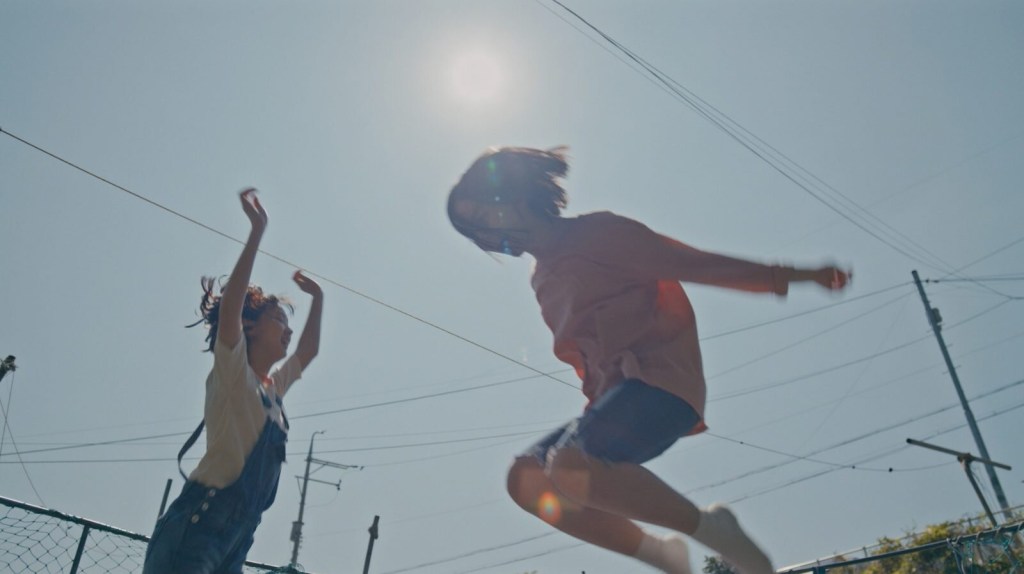
1961 marks a pivotal moment in South Korean history where the country, famished and left in a marginalized state after the Korean War, starts to rapidly develop. A historical event known as the Miracle on the Han River, the ‘60s and ‘90s in South Korea are recognized as a period of the country’s industrialization and the discarding of its image as victims of a horrifying war. Due to its rapid economic development, South Korea is now recognized as one of the wealthiest countries in the world. However, the repercussions created by this remained as unhealed trauma, haunting generation after generation, as the country’s capitalistic pursuit pushed people into perilous and rigorous jobs. This societal change slowly pulled one individual away from another, as alienation positioned itself as an unsurprising presence in human relationships. Directed by Kim Bora, the 2018 film House of Hummingbird delves into the lives of the youth during this historical moment; through the lens of the protagonist Eun-hee (Park Ji-hoo), House of Hummingbird opens conversations on one’s journey of self-discovery and breaking a painful cycle.
Alienation among people remains no stranger for Eun-hee’s family. Experiencing the direct aftermath of the Korean War, their struggles to survive, and the change of consumption and lifestyle habits in South Korea influenced by the West, Eun-hee’s parents place extreme emphasis on the importance of labor and higher education, hoping for a better future for their children. In the process, affected by their own unhealed generational trauma, they choose physical and emotional abuse to correct their children, while love and care remain extremely lacking. Rarely do we witness Eun-hee’s family exuding emotions of optimism; all five family members gather around the dinner table with a stifling silence suffocating them. Banter is absent, while conversations only consist of requests and admonishment.
As everyone becomes a victim of a rapidly developing society that offers no rest, love remains a luxury that only manifests through tragedies. It is the rare tear Eun-hee’s patriarchal father shows, and her mother placing a piece of meat on her spoon at the dinner table upon hearing the news of her surgery. Thus, Eun-hee resorts to finding value in her existence via the romantic interests in her life, just to be consumed by the inner turmoil she feels toward them. While Eun-hee suggests to her boyfriend Ji-wan (Jung Yoon-seo) that they kiss, she spits right afterwards, delineating the sense of unfulfillment that lingers inside her despite engaging in a supposedly loving act. While Eun-hee finds solace in Yu-ri’s (Seol Hye-in) romantic interest in her after her fallout with Ji-wan, her relationship with Yu-ri also ends up being short-lived, delineating the feigned romance and love these relationships are built upon.
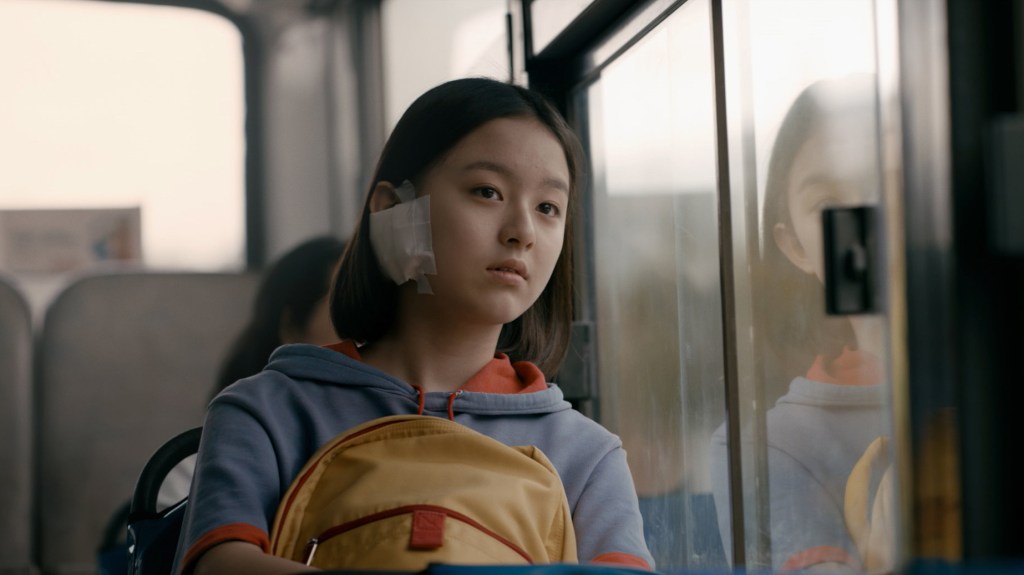
It is only after Eun-hee’s fateful encounter with Young-ji (Kim Sae-byuk), her new Chinese teacher, that she starts to understand what she deems important in her life. Amidst indifferent gazes and forced expectations, Young-ji is the only person who shows a sincere interest in Eun-hee. During their first encounter at the academy, when Eun-hee shyly shares her hobby of drawing comics, Young-ji smiles and responds, “I like comics, too.” Her hobby—usually unnoticed by her friends and family members and overshadowed by other supposedly important responsibilities in her life—is brought to light for the first time.
Young-ji further challenges Eun-hee to redefine love and aspirations in life by revealing how often she hates herself, despite conforming to society’s ideals of success. In other words, Eun-hee’s perception of her invisibility as the norm, as well as her understanding of life itself, is deeply challenged by Young-ji’s appearance. This is most notable during a scene at the hospital, when Eun-hee jokingly remarks that she feels more comfortable here than at home, implying the domestic violence she experiences regularly. Young-ji adamantly tells Eun-hee: “Don’t let anyone hit you anymore. If anyone ever hits you, do everything you can to fight back. Don’t ever just take it. Okay?”

Before Young-ji’s appearance in Eun-hee’s life, Eun-hee believed that the status quo was the norm—it’s difficult to determine whether your longing for love or the physical and emotional pain you experience is deserving of attention when everyone else remains to be living through similar unrest. In fact, Eun-hee’s unfulfilling life is considered privileged and normal, considered to be better than her father’s generation, as he roars about having to wake up at 4 AM to get ready for school when he was young. When Ji-suk, Eun-hee’s friend, reveals that her brother hit her in the face, the two start bantering about the diverse methods their brothers utilize to beat them. At school, rather than seeing karaoke as a typical activity middle school girls engage in to spend their youth, Eun-hee’s homeroom teacher sees it as a waste of time that could be instead spent studying.
Young-ji’s sincere request marks a change in Eun-hee’s life, as Eun-hee finds value in making her newfound voice heard amidst the oppression she is expected to accept as the norm. Eun-hee is able to confidently confront the head teacher of the Chinese academy for describing Young-ji as odd despite not knowing much about her. Eun-hee pushes her brother in response to his threat of if she wants a beating, reminding him of his academic incompetence despite his privileges as the only son in a patriarchal household, and involves herself in providing necessary attention to her hobby. When writing a letter to Young-ji thanking her for the sketchbook she has gifted, Eun-hee confidently promises the creation of a quirky character inspired by Young-ji, when she becomes a cartoonist. This scene marks Eun-hee’s certainty about the future she aspires to live, digressing from her past self, who mundanely engaged in activity only with the permission of an authority figure.
Hence, Young-ji holds great importance to Eun-hee, for she acts as the “why” that sparks the possibility of the absurdity of her life. Eun-hee asks herself, why must she be guilty of someone else’s mistake? Why must she get beaten by her brother? Why must she fulfill someone’s dreams, not hers? These questions hold immense significance for Eun-hee, for she understands how absurdly violence has naturalized itself into her life, affected by a country that has yet healed from its series of traumas. Most significantly, this series of questions opens a new beginning that ultimately ends the meaningless state of her life. The significance of this commencement lies in allowing Eun-hee’s active consciousness to take charge and trigger actions that result in change, rather than blindly assuming violence as the norm. Through this revelation of the absurdity of life is when Eun-hee understands her value as a person, and ultimately gains a sense of self—she no longer lives to please those who surveil her, but for herself.

While subtle, Eun-hee’s actions resolutely redirect the blame from herself to systemic issues, toward the country’s shortcomings to help heal people from prolonged trauma. In her redirecting the cause of banality, which plunges people into alienation, Eun-hee ultimately breaks the painful cycle of generational trauma. She no longer lets herself become victimized by factors that are dictated by the systems of society, and understands that she is correct for voicing what she deems unreasonable. This moment of revelation ultimately results in the act of healing; within this process, Eun-hee finally comprehends that her life has gained meaning.
Eun-hee’s redefinition of her life is reaffirmed after the falling of the Seong-su Bridge, which costs Young-ji his life. The collapse of the Seong-su Bridge in 1994 is one of the three tragedies in South Korea that directly resulted from poor construction and maintenance of infrastructure. This tragedy remains a strong connection to the Miracle of the Han River, where attempts to industrialize the country were rushed, resulting in the deaths of many innocent people. Eun-hee stares at the broken down Seong-su Bridge one morning with her sister as she closes her eyes to pray. When she opens them, her face is imbued with a subtle sense of determination.

Lives are directly and indirectly lost by the ramifications of a developing society; not only was Young-ji directly killed in the collapse of the Seong-su Bridge, but Eun-hee’s uncle was also hinted to have ended his own life, most likely due to ruthless labor environments at the time. Thus, Eun-hee’s eyes reflect a determination to live, for she understands that her will to live to her utmost potential revolves around a rebellious move to the status quo. Wholeheartedly rejecting the expectations that dawn upon her, surrounded by normalized environments of indifference that push people to succumbing to their lives both voluntarily and involuntarily, Eun-hee’s new perspective and personal desires transform into an ode of commemorating those whose lives have been taken away.
In a society of naturalized mechanicality, a look into oneself may yet be the most powerful act of defiance. As originality becomes obscured by a series of expectations that function to fuel a country continuing to benefit from the pain of its people, wholeheartedly engaging in making one’s fondest dreams happen, redirecting the blame from oneself to the system, and most importantly, having a genuine will to live– having a life that one can define as meaningful, may be the most rebellious act one can engage in. And although ambiguous questions linger “How long can we be rebellious of the present, and will change ever come through? How much should we compromise with the present?” – what holds significance are the spontaneous sparks of encounters that, even momentarily, free us from the banal mechanicality of the everyday.




 Flip Screen
Leave a comment