
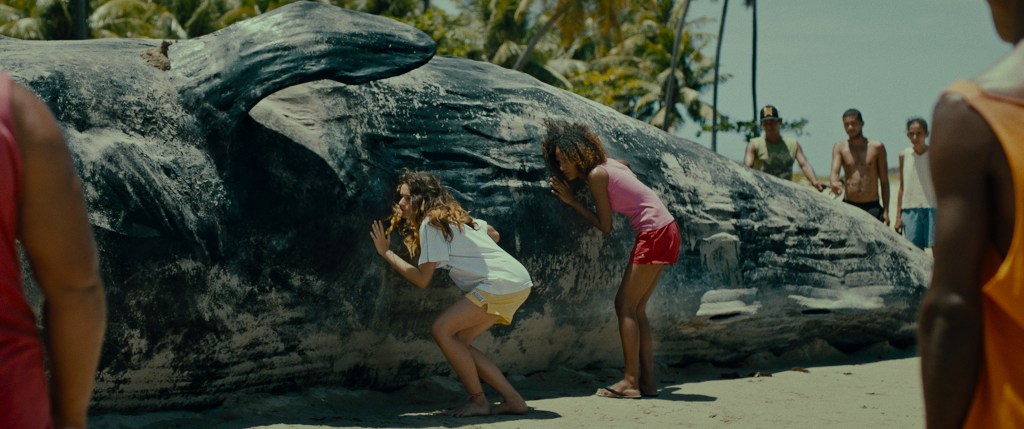
“A highly sensorial exploration of adolescence, class, and longing set against the backdrop of Brazilian coastal nature”
Directed by Brazilian duo Nara Normande and Tião, Heartless (original title: Sem Coração) is based on their short film of the same name, which received the Illy Prize for Best Short at Directors’ Fortnight during the 2014 Cannes Film Festival. The year is 1996 and Tamara (Maya de Vicq) is enjoying her last weeks of freedom at the fishing village she lives in before departing to Brasília for her studies. One day, she hears about Heartless (Eduarda Samara), a teenager whose nickname derives from a scar she has on her chest. Throughout the summer, Tamara feels a growing attraction and curiosity towards the mysterious girl.
The first thing introduced to viewers is the sound of the ocean. A girl, Heartless, is seen diving in search of an octopus. Her determination is juxtaposed with the images of a group of kids, Tamara and her friends, drifting purposelessly around in search of adventure. It’s fitting to introduce viewers to the ocean so early, as it’s so frequently featured—visually and in sound—but also how it’s associated with either leisure or work depending on the character. Moreover, the film also introduces various species of fish, including offering a fitting connection between Heartless and stingrays—an animal thought of by some people as one of the most misunderstood due to, in part, people not knowing very much about the creatures.
Unravelling in Alagoas, one of the poorest states of Brazil, the theme of class is interwoven in a myriad of ways. Tamara’s free-spirited middle-class parents live in a house filled with culture as they indulge in food. In contrast, Heartless and her father live much more modestly and rarely have enough groceries to feed them both. Similarly, while some people can live and move freely, others don’t have the same opportunities at their disposal. While Tamara herself is both glad and sad to be leaving, her friends move from worrying that she will forget them when she leaves to wishing that they could join her in the search for a better life somewhere else. When young, one might not always comprehend one’s surroundings and recognise the social differences in society. However, as one grows older, one begins to notice these disparities—and with it, one’s privileges—and it’s a realisation that is quite difficult to confront, as evident through Tamara’s gradual journey.

Another portrayal of class differences presents itself when Heartless delivers an order of fresh seafood to a group of Italians. When she enters their home, it’s impossible to ignore the big open spaces and large windows offering so much natural light. Inside, lethargic people lounge about in their swimwear, drinking, eating, smoking and sunbathing their days away by the pool as half-filled bottles and glasses are haphazardly abandoned around them. This strongly defined setting featuring bourgeois characters immediately echoed similar images in Lucrecia Martel’s La Ciénaga. The debut feature by the Argentine filmmaker uses the symbol of a private swimming pool—an unmissable symbol of wealth—to showcase the family’s decline from their upper-class status as the pool is decrepit and dirty. In Heartless, the various swimming pools range from the pristine private ones to the empty communal one with dirt that not even heavy rain washes away.
As seen through Tamara and her mother, Heartless and her father and Galego (Alaysson Emanuel) and his father—relationships that all carry depth albeit different complexities—introduces another prominent theme, namely the examination of parent-child relationships. While the two aforementioned relationships convey care and support, a heartbreaking portrayal emerges in the dynamic between Galego and his father. When Galego, fresh out of jail, first reunites with the friend group, everyone is excited. When asked, he talks casually about prison and underlines how it felt better there than at home, and the group attentively listens to every word. Therefore, it becomes painful when it becomes apparent that his reality is different from the one he is describing. After a couple of bloody attacks endured after his father tracks him down, Galego’s façade fully crumbles in front of everyone. Like waves crashing into the shore, Galego spills everything all at once about what his life is really like.
Even though the film initially positions Heartless as the main mystery of the film, both narratively and through its title, the film doesn’t centre as much on Heartless as viewers might first think. Instead, it feels as if the story is about all of these kids and how they interact and chooses to not interact with each other and why that is. In itself, the word heartless can refer to someone who acts cruelly, someone callous and unkind. However, in this instance, it might be less about people than the circumstances people find themselves within. The setting might be beautiful, but danger and violence linger in the air, along with homophobia and various prejudices. Ultimately, these kids understand the duality of humans better than any adult—many of these adults see people unambiguously and are of the notion that people can’t change or act differently in comparison to their past. This idea undoubtedly lines up with the film’s additional layer of corruption.
While the inclusion of a news segment covering the death of PC Farias—a central figure in the corruption scandal that resulted in Fernando Collor de Mello’s 1992 removal from Brazil’s presidential office—covers a bigger kind of corruption, there are also smaller kinds. These examples, covering the corruption of morality and character, have no disregard for class distinctions whatsoever. During one of the adventures, the kids break into a neighbour’s house, mostly for the fun of trying on someone else’s life. When Tamara’s neighbours later arrive to interrogate the children about their break-in and a missing watch, it becomes obvious that before the couple even entered the house, they had already decided who was to blame. Due to prejudices and Galego’s background, suspicion lands on him. In reality, Tamara’s brother Vitinho (Ian Boechat) stole the watch.

Even though the issues of class are mature and intricate, they are handled with care and presented in a way that feels natural and not sensationalised. Still, as the core group consists of teenagers, aspects of the adolescent experience also arise. With the exploration of the in-between state of being caught between childhood innocence and burgeoning young adulthood comes the curiosity of sexuality, for instance, shown through the viewing of pornography. During a sleepover with her girlfriends, Tamara cautiously slips one hand underneath the cover and begins masturbating to the images of naked women playing on the television in their room. Later, four boys from the friend group go through the neighbours’ VHS collection of pornography, reading the descriptions of each film with a combination of awe, confusion and excitement. The image then cuts to them all sitting on the bed, masturbating in unison, managing to be both an individual and communal experience.
Overall, the film’s portrayal of intimacy evokes compelling interest. When Tamara one day follows Heartless, she discovers that she secretly meets up with some of the boys at the empty swimming pool to have sex. The fully clothed act is sterile, presented more like a transaction, and far detached from something even remotely exciting for either participant. Heartless is uninterested, but she also comes across as being in command as she instructs the boy how to move and decides which boy should come next when done. This is even more intriguing as other images of seemingly more innocent acts—holding hands, asking about someone’s real name, kissing, and prolonged eye contact—prove to be much more intimate. This idea culminates when Tamara reaches out to touch Heartless’ scar and Heartless allows her while Double You’s cover of the KC and the Sunshine Band song “Please Don’t Go” plays in the background to convey what might not be explicitly said.
Shot digitally by cinematographer Evgenia Alexandrova, the film features eye-popping work presented in an organic way that does justice to the natural beauty of the environment. The image of Binho (Kaique Brito) kissing his boyfriend, passionately but secretly, as the heavy rain pours down on them comes to mind, as does the image of Heartless in her vibrant red bathing suit against the blues and greens of the ocean. It’s at its most visually stunning when playing with composition, framing and colour, with one of the most beautiful images being when the kids all join together in one big embrace during a vulnerable moment unravelling in the shallow water. Constructed by eight separate bodies, but in that moment, they are as one. Additionally, the audio is most exciting when it introduces recurring themes between sounds that don’t naturally occur within a specific scene, including crackling fire, a heart beating or ocean waves. Still, certain creative decisions are better than others—aligning the camera in the water with the kids makes the viewer feel as if they are one of them; playing around with the effects of displaying images at a slower rate to present them in a flickering and choppy way is not as effective.

During its 91-minute runtime, Heartless proves to be a highly sensorial exploration of adolescence, class, and longing set against the backdrop of Brazilian coastal nature. While the film’s narrative manages to successfully explore its themes in a way that comes across as both powerful and organic, the film, unfortunately, falters momentarily when it engages in its hit-or-miss fantastical elements—sometimes clumsy, other times they convey the characters’ inner turmoil effectively. Despite the fact that the entire film features believable acting performances, the young characters are undoubtedly the heart of the film, most of them portrayed by non-professional actors from the region. Besides the protagonists, the comedic timing and pure heart conveyed by Lucas Da Silva as Cidão, the complexity within Galego portrayed by Emanuel and Brito who manages to convey both Binho’s unbridled queer joy and devastation as he can’t live freely, are all standout performances.
These kids practically live in their bathing suits and swimwear, as there is no point taking them off as the next splash is only so far away. They embody childhood innocence and carefreeness as they roam around, but all are not as free as they might seem. Initially, Heartless might appear to be a mystery, but at its core, it’s all about people and the complexity of human relationships. It’s about deep longing—for someone or somewhere—and the heartbreaking realisation that not all of these desires are offered equally to the ones who dream of them.
Directors: Nara Normande, Tião
Screenplay: Nara Normande, Tião
Producers: Cinemascópio (Emilie Lesclaux, Kleber Mendonça Filho), Les Valseurs (Justin Pechberty, Damien Megherbi), Nefertiti Film (Nadia Trevisan, Alberto Fasulo)
Cast: Maya de Vicq, Eduarda Samara, Alaysson Emanuel, Maeve Jinkings, Eules Assis, Kaique Brito, Erom Cordeiro, Ian Boechat, Lucas Da Silva, Elany Santos
Editors: Juliana Munhoz, Eduardo Serrano, Isabelle Manquillet
Release Date: September 5, 2023 (World Premiere)



 Flip Screen
Leave a comment