
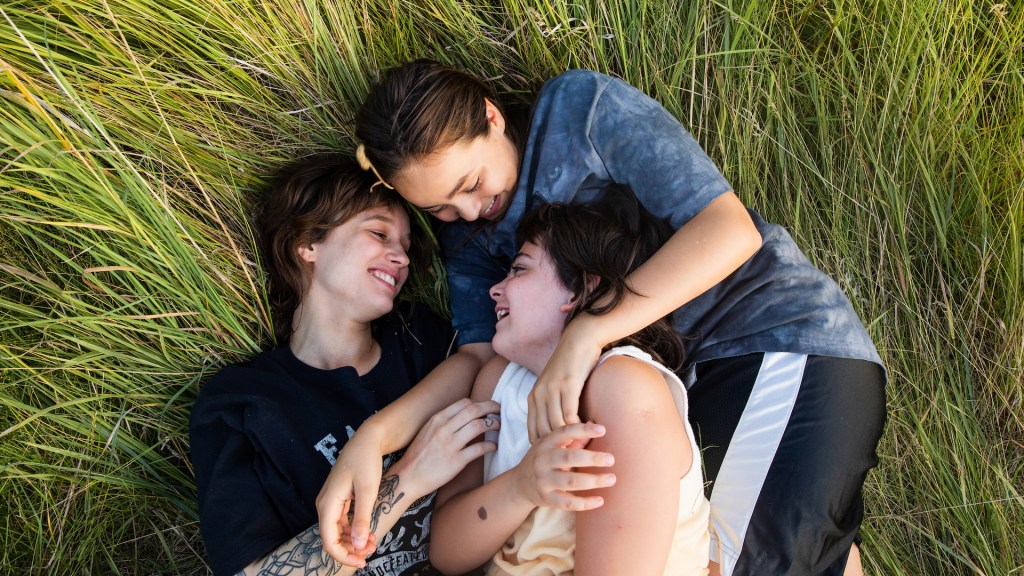
“An equally beautiful and heartbreaking coming-of-age tale that delicately balances humour with pain”
Having a sibling is perfectly summed up in the act of telling a person to go to hell and then worrying about them getting there safely—it’s an intricate relationship filled with both frustration and love. Although commonly portrayed, it isn’t always easy to authentically present these connections simply due to their characteristic complexity. Paradise is Burning (original title: Paradiset brinner) does it successfully though, as it finds the right balance between conveying how strongly these sisters feel about each other and how much they can end up hurting each other due to the very same reason.
In a working-class area of Sweden, sisters Laura (Bianca Delbravo), Mira (Dilvin Asaad), and Steffi (Safira Mossberg) have learned to fend for themselves despite an absent mother. The anarchistic trio con and scam their way through life’s hurdles and they have learned through trial and error which ways are the most successful. They’re savvy and make do with what they have and stumble upon. With summer burgeoning, they spend their days joyously carefree lounging poolside at houses that don’t belong to them. However, when the social services sense trouble and arrange a date for a meeting, Laura is forced to find someone to impersonate their mother. With the noble intent of not worrying her younger sisters, Laura keeps the information to herself as she tries to find a solution. Alongside the impending meeting, new tensions arise and life is clearly about to change—in all aspects of the meaning.
Shot in and around Stockholm, the film bursts with life and vibrancy in not just its characters but in the environments in which they move through. Presenting a universe that feels lived in, additional details about the sisters’ surroundings add to the viewing experience of getting to know their world. This includes Sasha (Mitja Siren), a Finnish man who sings karaoke at the local bar, the girls’ neighbour Zara (Marta Oldenburg), and the local corner shop that allows the underage Laura to buy cigarettes as long as no other customers are present to witness the exchange. As the idea of three sisters roaming wild and free almost feels like something out of a surreal children’s book, the more fantastical elements of the narrative—in particular how they celebrate and honour rites of passage and have ceremonies for transformative experiences—suit wonderfully.

A celebration of sisterhood, the film emphasises how people shape each other whilst creating and sharing key moments of adolescence and growing up. Although the film underlines the sisters’ unity, it also emphasises their individuality and the importance of having separate experiences to evolve. Their bond—a blessing and a curse all at the same time—is undoubtedly the heart of the film. However, where there’s a heart, there’s always the risk of it breaking. When Laura begins spending more time escaping reality away from her sisters, a rift appears in their relationship, proving that withholding information hurts more than the truth itself. When introducing this element to the narrative, the girls’ divided journeys end up both reflecting and highlighting their closeness and loneliness depending on whether they’re together or apart.
The casting process, which took more than ten months, eventually resulted in the casting of Delbravo, Asaad, and Mossberg as the captivating main leads and after seeing the results, there’s no imagining that anyone else could’ve portrayed these sisters better than they did. Fully embodying their respective character, the trio’s unmissable chemistry transcends the screen. Whether they’re arguing, teasing each other or looking after one another, there’s an organic feel to how they interact and their performances never feel melodramatic or exaggerated. In addition to drama, the film is very funny and each source of comedy for the girls—for instance, Laura’s quick wittiness and Steffi’s childlike innocence—is very appropriate not just for their respective ages but also depending on where they sit within the family hierarchy.
The wonderful chemistry doesn’t stop with the sisters but rather extends to all characters and the numerous compelling relationships that evolve throughout the film, especially the one between Laura and Hannah (Ida Engvoll) after their happenstance meeting. Right from the start, there’s a spark between them—an almost tangible undefined attraction—that will only deepen as they find themselves spending more time together. Their interactions feel like a dance, reminiscent of the bullfight Laura witnessed on television in an earlier moment, as they try to read each other’s reactions to try and figure out the next step. When Hannah learns that Laura breaks into other people’s homes—not to steal but to just “hang out”—Hannah is both intrigued and impressed and doesn’t seem to hesitate when asking if Laura can show her how she does it. Still, it bears mentioning that bullfights always end in destruction.
When Hannah eventually asks about Laura’s parents, she echoes Pippi Longstocking and says that her mother is dead and that her father is a pirate. The unconventional character, created by Astrid Lindgren, lives an independent lifestyle without her parents and the similarities continue. While Pippi is generous, unpredictable, wise, and true to herself, she also has a propensity to lie and be selfish and ignorant at times. Like a bull, Laura protects her herd, but whilst doing this she also pushes her own emotions aside to not deal with them publicly and risk worrying the people around her. Throughout the film, other people consistently take Laura for her word, regardless if they believe what she is saying or not, but Hannah sees through her. She takes the time to question her, but she isn’t just pressuring her to be more truthful, Hannah also makes it feel as if Laura can be honest in her company. Laura is seen deflecting and pushing herself aside during several moments in the film, but Hannah doesn’t allow her this opportunity.

Delbravo and Engvoll have riveting chemistry and it’s intriguing to witness the thrilling dynamic unravelling between them. Even though their respective desires for an escape originate from dissimilar causes, the joy they feel whilst engaging in their life away from home is indistinguishable. While the paradise mentioned in the title very much refers to the one the sisters have created for themselves, it also refers to these moments exploring other people’s homes as a break from reality—of pretending to be someone else and forgetting about one’s problems and responsibilities, even if only temporarily. Still, regardless of how real it feels, it’s all make-believe.
While made with a lot of care, Paradise is Burning is also made with a strong vision. Throughout the film, there’s a noticeable amount of sophistication conveyed through its imagery as cinematographer Sine Vadstrup Brooker so precisely captures and presents the contrasting emotions echoed within the story—underlining its poetry, playfulness and rebelliousness. There are examples of the fourth wall momentarily breaking, along with the repetition of certain images happening successively and the use of interesting camera angles— creative decisions that all make the moments in which they appear feel memorable. Moreover, the soundtrack is carefully chosen to heighten each scene they appear in. The songs—which include Sara Parkman’s “Kyrie/Sjung, syster sjung!” and Fever Ray’s “Keep the Streets Empty for Me”—are as vast as the emotions explored within the narrative. Still, despite strong competition, there’s one use of combining the right song with the right visuals that ends up being the most breathtaking of all.
Broken into yet another home and dressed in the owner’s expensive shiny clothing, Laura and Hannah dance to Kendal Johansson’s achingly raw cover of Big Star’s “Blue Moon.” Then, via a 360-degree pan, the camera moves past abandoned plates of food and glasses of wine left haphazardly within the bourgeois home to eventually arrive at the couple now sitting slouched on a sofa smoking. Their positions, Hannah leaning her head back while Laura rests her head on Hannah’s lap, resembles a painting and watching them feels like watching an image stuck in time. As a light source suddenly hits them, the moment feels ethereal, and the dimly lit setting and surrounding graininess only add to that sentiment. At first, viewers might think its source is the headlights of an approaching car, driven by someone about to return home to spoil the fantasy. In reality, it isn’t, but it might as well have been as this moment cements itself as a turning point. The essence of this entire scene—how it so precisely conveys everything the film is about, namely the occurrence of beauty and ache simultaneously—makes this not just one of the most gorgeous moments within the film but one of the most stunning of the year.
One of the three candidates to become Sweden’s submission for an Oscar for Best International Feature Film (the other two being Opponent by Milad Alami and Together 99 by Lukas Moodysson), Paradise is Burning evokes a whirlwind of emotions. During the film’s 108-minute runtime, viewers will experience an equally beautiful and heartbreaking coming-of-age tale that delicately balances humour with pain as it introduces characters one will care for long after the end credits have finished. The sisters, all existing within three different stages of girlhood, carry their own inner turmoil, including worrying that they’re not doing enough or being enough. Valuing these stories as stories worthy to be seen and heard, Mika Gustafson and Alexander Öhrstrand’s script allows these girls to be their complex and messy selves without ever passing judgement. Furthermore, as she draws out evocative performances from her young cast, Gustafson’s first fiction feature isn’t solely an incredibly strong debut, but one of the best Swedish films in recent memory. As it explores the fine line between the euphoria of complete freedom and the harsh realities of growing up, the atmospheric film—like its characters—ends up being tender and powerful all at once.
Director: Mika Gustafson
Screenplay: Mika Gustafson, Alexander Öhrstrand
Producers: Hobab (Nima Yousefi), Intramovies (Marco Valerio Fusco, Micaela Fusco), ToolBox Film (Maria Stevnbak Westergren), Tuffi Films (Venla Hellstedt, Jenni Jauri)
Cast: Bianca Delbravo, Dilvin Asaad, Safira Mossberg, Ida Engvoll, Mitja Siren, Marta Oldenburg, Andrea Edwards
Editor: Anders Skov
Release Date: September 7, 2023 (World Premiere), 14 October, 2023 (BFI London Film Festival), 27 October, 2023 (Sweden)


 Flip Screen
Leave a comment