
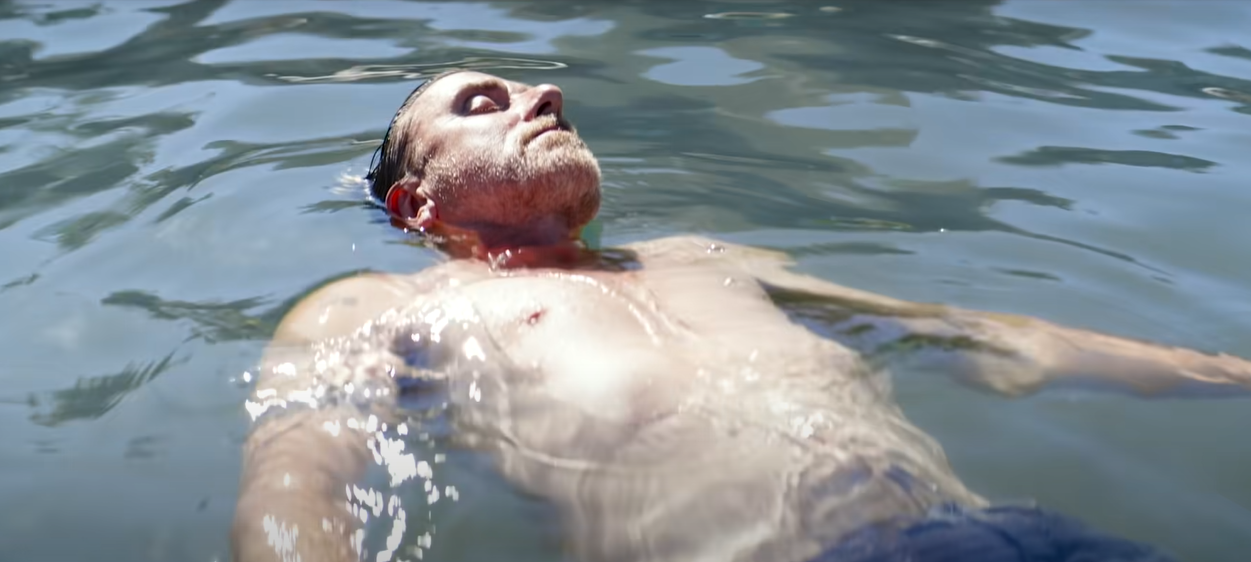
In 2021 M. Night Shyamalan’s Old had placed unsuspecting tourists at an idyllic seaside resort, their every whim anticipated by eager-to-please hosts. A bus driver (Shyamalan himself, uncredited since the film has no end credits scroll), promising to return by nightfall, deposits them on the hard-to-find beach of a spacious and pristine ocean cove, where the drama strands them. 2022’s Sundown introduces its tourist family already in full vacation mode, with time slowed down. In both cases, the only indication something may be amiss is that the leisurely pace of time is sped up in the titles of both films. What does getting old—or nightfall—have to do with the cyclical rhythms of the seaside for these oblivious daytime sunbathers?
Developments early in both films hint at implacable forces, at odds with their characters’ relaxation. We might think of these forces as illustrating the thermodynamic “entropy” principle in physics, which says that natural processes, over time, move in one direction toward increased disorder. (Like the sand grains of a sandcastle on the shore.) Old will accelerate the dispersions of illness and aging, while Sundown will chart the degradation of Neil’s health along with the structured order of the family. Despite the similarities, the two movies couldn’t be more stylistically divergent, Sundown arguably the more subtle and artfully told story.
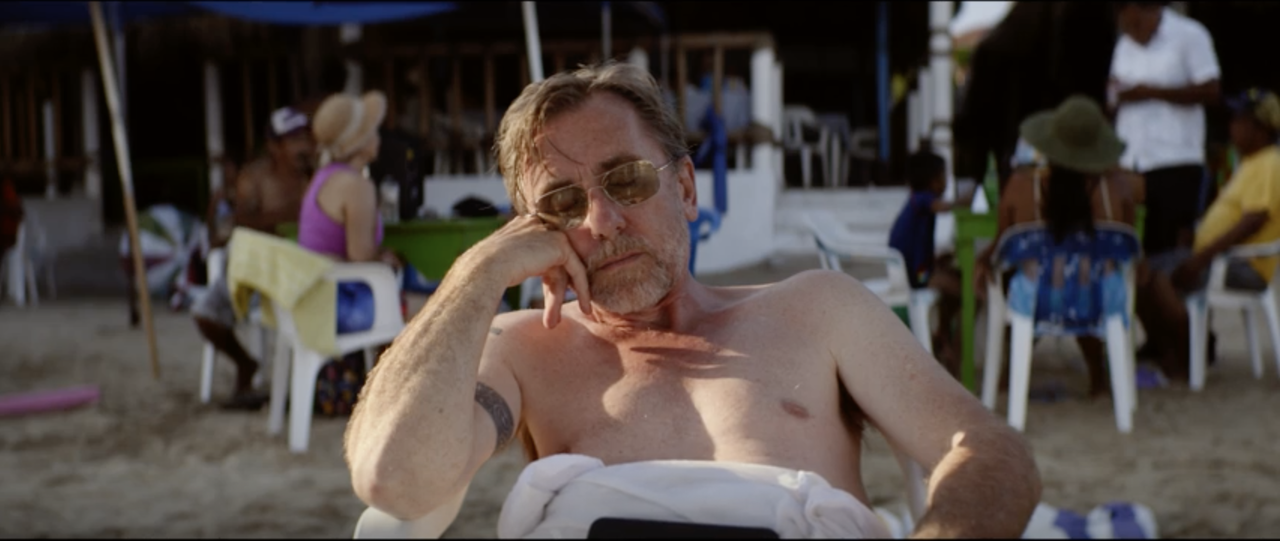
Sundown‘s haute bourgeoise family is certainly wealthier than the middle-class beachgoers of Old. A mother, daughter, son, and man about her age—whom audiences at first take to be the husband and father—lounge rather tediously around infinity designer swimming pools and on sun decks, taking in the views high up in the hills of their luxury resort. The director’s aloof, stationary, and sometimes bird’s-eye view camera framing accentuates the characters’ elegant remove from life’s common cares and discomforts. They are evidently accustomed to hand-and-foot service from the help, and the steady poolside delivery of margaritas, massages and elaborate cuisine. Only sporadically does Alice Bennett (Charlotte Gainsbourg, her accent a cosmopolitan English), tend to her phone calls, resisting her children’s invitations to join in a board game on the terrace. She’s the diligent one, while detached Neil Bennett (Tim Roth) takes no part in business-related doings, content to sunbathe or hover over dying fish flopping on the sand beyond the water’s edge.
This image of helpless and marooned nature in the midst of its exclusive bounty for privileged human consumption carries an undercurrent of social commentary never far removed from a larger existential worldview which, for better or worse, centers around Neil. Events soon take on a more philosophical subtext, bringing to mind the opening lines of Albert Camus’ The Stranger, similarly set by the sea. “Maman died today. Or, maybe, yesterday; I can’t be sure,” sounds its oddly discordant note. (In both films yesterdays blend imperceptibly into tomorrows both before and after disasters strike.)
Alice answers a cell phone call no one should have to receive on vacation— her mother is gravely ill. In the airport taxi she is shattered by the news of her death and must face the added shock of Neil announcing he left his passport behind and can’t accompany them home. Neil goes through the motions of shrugging and shuffling around in a sloppy white linen shirt and sandals, enigmatically arranging a second “vacation” for himself— and as they used to say, in colonial empire-speak—going native in a seedier district of Acapulco—which makes for a greatly understated performance from Roth. You cannot quite unreservedly credit the director for satirizing the presumption of white privilege if only because grizzled, indifferent Neil is so passively complicit in his fate, even chummy (for him) with the questionable local characters he hangs out among, drinking beer after beer by the seashore.

To be unreadable may be as cultivated a feat for an actor as emoting and overtly soliciting an audience’s sympathy. It’s a kind of vacation from both acting and the conventional contract between a protagonist and a film viewer trying to piece together the meaning of a story beyond just going with its flow. I for one was so lulled by the minimalist narrative and dialogue, narcotized by the sensuous details of Neil’s daily far niente, as to not pick up earlier clues about his identity within the family. He proceeds to rent a low-budget hotel room near the beach and takes up with a young Mexican woman (Iazua Larios) he regularly buys bottles of beer from at a small bodega. Over the course of their minimal but probing conversation together in halting English, Neil explains to Berenice that he is unmarried but has a sister and niece and nephew he loves very much. The fact that he is indeed Alice’s brother rather than her husband reframes the situation considerably and is the first of successive revelations. Whatever his exasperating unwillingness to even answer his sister’s phone calls (having first lied to her about his progress obtaining a new passport) and however well-deserved her abuse of him on finding him on the beach lolling in his lounge chair, the fact is he has, at least, not been fecklessly unfaithful (except as a brother).
However, sometimes not playing one’s assigned, expected social and familial roles can prove more lethal or subversive than waking up to one’s deep moral implication in the general exploitation. We avoid so many dangers in life by surrendering to convention. Here is where the dramatic outcome of Old‘s hyper-aging diverges conclusively from Sundown‘s low-key character study in lethargy—the matured surviving son and daughter in Old turning out to be heroes, breaking the cycle of scientific exploitation of guests by escaping from the cove and exposing it. Curiously, Shyamalan’s audience may be reminded much more of the dénouement of Duncan Jones’ Moon (2009), where Sam Rockwell’s Sam Bell solves the mystery of his expendable clone identity and returns to earth to expose the corporate malfeasance.
Neil, is no hero. Alice tracks him down and her return to the country unleashes a cascade of Kafkaesque catastrophes he is helpless to avert. She and the family solicitor Richard (Henry Goodman) are followed in their car by Neil’s suspicious beach and taxi companions who have devised what appears to be a kidnapping plan of Alice for ransom, taking place entirely off-screen. We infer these motives only over the course of a fragmentary episode where the schemers get involved in a highway shootout with the driver, in which Alice dies and Richard is injured. This is where the film might have pivoted to a more conventional thriller where a Mexican detective-type investigates Neil’s connection to his heiress sister’s killers, discovering that he is now heir to her fortune from the siblings’ inherited industrialized slaughterhouse enterprise. It is not entirely clear whether the business is located in London or on Mexican soil, as interspersed shots show a small group of local swine noisily roaming the water’s edge—presumably meant as a reminder of the living “commodity” at the source of the siblings’ and their deceased mother’s immense fortune.
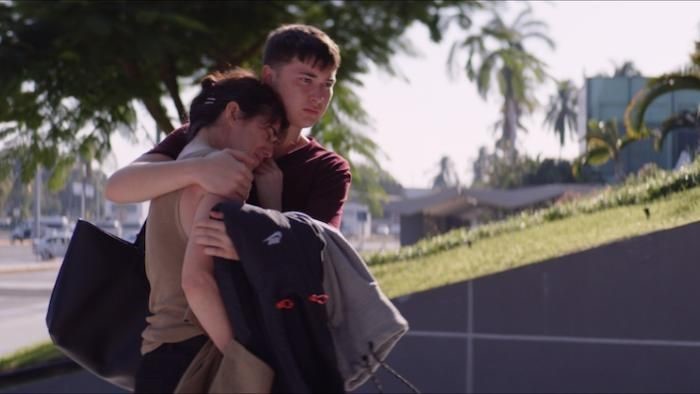
Instead, the director removes the need for such exposition and plot devices. Viewers are left to puzzle things out, with tabloid print newspaper headlines doing a non-existent gumshoe’s work for us. Scenes show the British consular officer in Mexico managing to have the suspect Neil released from prison, and suffering a bottle smash to the head by his infuriated nephew Colin (Samuel Bottomley) in a meeting where he and his niece Alexa (Albertine Kotting McMillan) blame him for his mother’s death. He then signs away any legal claim to shares of the family business, with only a modest stipend to see him through the rest of his life and cover medical bills for what Richard alludes to as Neil’s “condition”.
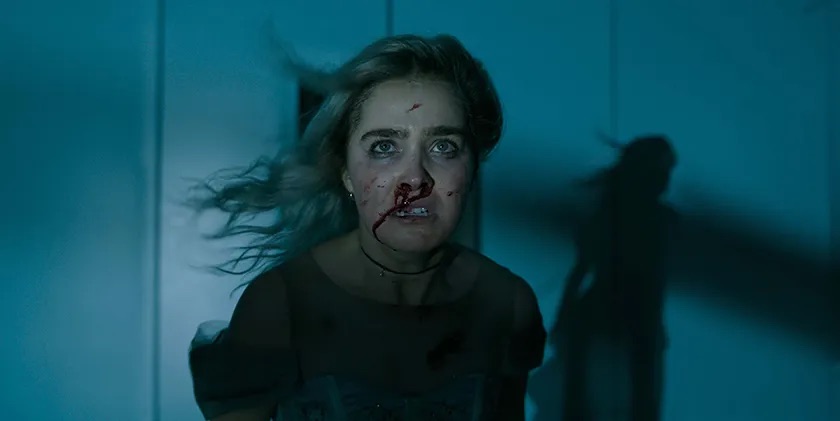
While director Franco eschews the potential for melodrama in all this, Shyamalan lathers it on in contrast, staging some excruciating sunlit and nighttime scenes in Old. Above all, the need for understanding Neil’s motivation is what ensures the film rises above its expositional gaps to become what is ultimately a kind of existential fable. So as to avoid spoilers, I leave the exact nature of Neil’s “condition”, which is unveiled to us so late in the game, unrevealed. His unspoken affinity with those stray biological specimens—the fish out of water, the swine on the beach, and an oddly surreal, fourth-wall-shattering image of a horribly disemboweled pig on the floor in Neil and Berenice’s new hotel room, which they cannot see themselves—turns out in hindsight to involve a fate shared by all sentient living things. Still, there is not, however, some strident message of reprimand for how human beings ignore, destroy, or eat their fellow creatures. Cold as interspecies cruelty may be, it is also shown to be part of the cycle of life and death. It may be that in Old, aging is similarly posited as a natural occurrence. But based on the premise of the Swiss graphic novel Sandcastle that inspired it, speeding up the life cycle may also, beyond the pathos, serve as a meta-commentary on the film director and editor’s control over Time, where Sundown remains more realistic.
The moral accounting (such as it is) for Neil’s mysterious behavior makes sense of it only in light of the story’s final twist. There is not a categorical judgment of his reprehensible indifference to his sister’s taking upon herself the funeral obligations back home, while receiving no answers about Neil’s whereabouts (not to mention his responsibility for her death). What we learn about what he was facing all along, also alone, is an explanation of sorts, if hardly a vindication, of his deplorable actions. We see him display a tenderness toward Berenice, which may be about the only gesture possible under his hopeless personal circumstances. The adage of complacency whereby Tout comprendre, c’est tout pardonner (the more fully we understand their situation, the easier we find it to make excuses for the offending person) is hard to rule out in a case far more complicated than the story enables the viewer to grasp on the surface. What seems episodic proves to be tightly structured in this slow-burn existential thriller. Its inversion of an enjoyable travelogue or comedic “holiday film” thus differs from Old‘s suspenseful premise of what is, essentially, Shyamalan’s working within the sci-fi and horror genre. Sundown offers its own sad rewards of sustained attention and semi-catharsis by confronting a deeper question: what can it mean for an individual to vacate the world itself?



 Flip Screen
Leave a comment