

Christos Nikou’s English-language debut Fingernails is a compelling exploration of the inexplicable and incalculable nature of love in a world so determined to define and measure it. It takes place in an alternate reality where new technology claims to have the power to determine a couple’s compatibility, solely by testing their fingernails.
Even in a world where compatibility can supposedly be calculated, our protagonist is plagued by uncertainty. Anna (Jessie Buckley) and her boyfriend Ryan (Jeremy Allen White) are an ostensibly perfect couple. After receiving a 100% positive result on the love test, they are deemed ‘one of the lucky ones’ and can be confident in the love they feel for one
another. Or so they are told. Clearly sensing something is missing in the relationship, however, Anna secretly takes a job at the love institute to gain a better understanding of the test and its training programme. She begins assisting couples who are about to take the test, having them take part in ‘love exercises’ that aim to strengthen the couple’s relationship and maximise the chances of a positive test. Whilst working at the institute, Anna forms a close relationship with her colleague Amir (Riz Ahmed), who is just as intrigued by the inner workings of the test as Anna. As their relationship develops, she begins to question the validity of the test and how much she can trust her own feelings. The film raises the question of whether or not you can ever be certain when it comes to love, and whether science and reason are ever more reliable than passion and feeling.

Through its investigation of this question, Fingernails highlights the risk of becoming complacent in relationships and the dangers of assuming that love can be so easily measured. Anna‘s partner Ryan dismisses the idea of taking part in the love training sessions, suggesting that, because they have already tested positive in the test, the couple have no need for such exercises. Anna surreptitiously attempts to utilise the techniques she has learnt through her role at the love institute to combat the stagnation she feels in her relationship, made all the more alarming by her burgeoning feelings for Amir. Fingernails displays the classic battle between head and heart, and exposes the influence of outside
factors on what we view as logical and accurate. The film raises the question of free will in love, is it something that can be biologically determined or is it an elusive and unpredictable force we have to believe in to make it work?
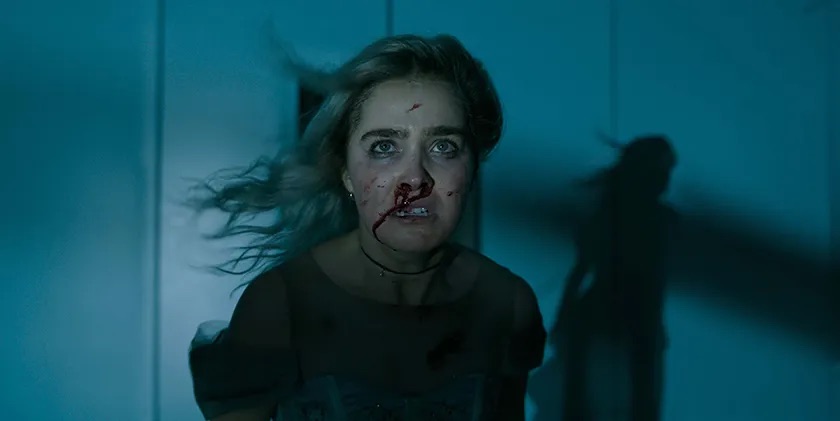
The scenes in which the test subjects are depicted having their fingernails removed are jarringly unpleasant, with numerous members of the cinema audience (including myself) visibly squirming and averting their eyes. The contrast between this and scenes in which the
test subjects watch marathons of Hugh Grant films, under the claim that ‘nobody understands love more’, highlights this metaphor for the different sides to love. With the juxtaposition of the film’s retro feel and romantic colour palette with this brutal physical act, Nikou reveals how this is not a traditional film about love. The title Fingernails intentionally
does not conjure images of romance. It sets the film up as one about the pain and complexities of love, investigating the notion, to quote the infamous response from Charles upon his engagement to Diana, of ‘whatever in love means’.
Ripping out of fingernails being the method by which love is determined echoes its historic use as a torture device. The characters endure physical pain just so they can be told if they are truly in love with their partner. The irony, however, is that the film acknowledges that the
test is not definitive and unconditional. It will reveal if both members are truly in love at that time, but also recognises that feelings can change. The film shows couples who have previously tested positive in the test opting to retake it, to ensure that they are still right for one another. Whilst the test is designed to eliminate the risks of love, to avoid divorce and heartbreak, in reality the risk remains the same. If it is possible that a couple who previously tested positive could test negative upon retaking the test, then what purpose does the test really serve? This flawed aspect of the test reveals the interconnected nature of pain and love, and the futile nature of any attempt to separate them. To love is to risk loss, eliminating this risk prevents what can be gained.
By the end of the film, Anna realises the inadequacy of this system and absurdity of having to reconcile how she feels with what she has been told by a machine. The film ends with a message reinforcing the importance of trusting one’s feelings, emphasising that love is not something you have to be told that you feel, but, despite how painful it may be, is something that you know.



 Flip Screen
Leave a comment