Park Chan-Wook’s Stoker opens with a shot of a girl crossing the road. She walks leisurely, assuredly. She looks down at something that we cannot yet see. In a voiceover, she tells us: “Just as a flower does not choose its colour, we are not responsible for what we have come to be. Only once you realise this do you become free. And to become adult is to become free.”
The girl is India Stoker (played by Mia Wasikowska), and this is where she’ll be at the end of the movie, though we don’t know that yet. Stoker is the story of India’s journey to arrive at this truth—her journey to adulthood. This journey finds echoes in another story: that of Camille Preaker (Amy Adams) in HBO’s miniseries Sharp Objects, directed by Jean-Marc Vallée. Both India and Camille are poised on the precipice between adolescence and adulthood. They must reckon with the people and the histories that make them who they are. In these stories, growing up is an act of violence, and the past is inescapable.
In Stoker, we meet India in a big, sprawling house. She lives here with her mother Evelyn (Nicole Kidman), with whom she shares a relationship that is just short of cold. India is on the brink of multiple changes—she is newly eighteen, her father has passed away in a car accident, and a new visitor is about to come into her life: her estranged uncle Charlie (Matthew Goode), whose presence brings unease. In every interaction, we sense something off in his intense gaze, his slight smile that suggests an ulterior motive. He flirts with both Evelyn and India in equal measure. He deliberately seeks out India’s company—on the spiralling staircase, the house’s centrepiece, he encourages her to stand with him on equal footing; across a dinner table, they hold eye contact, a beat too long.

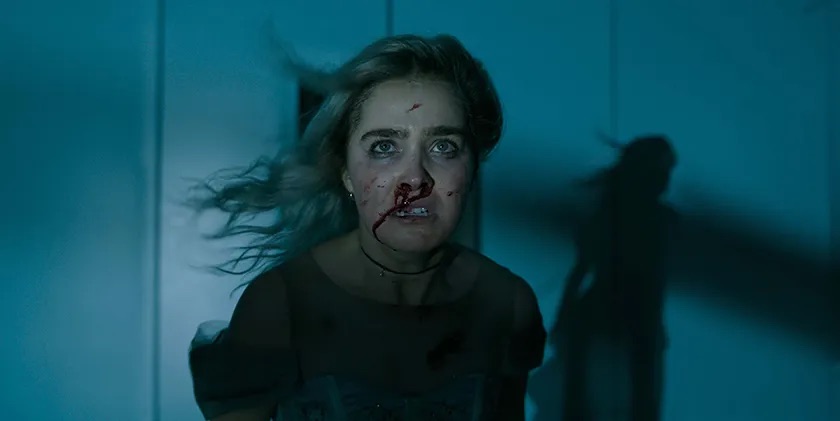
Unsurprisingly, Charlie’s intentions are not wholly pure. When approached by people from his past who claim to know the truth—the housekeeper, or India’s aunt—he makes quick work of them, strangling them with his bare hands or a belt, and burying them in the garden or under piles of ice in the freezer. India uncovers this with horror, but also with fascination. In one of the film’s most memorable scenes, India stands in the shower, remembering the events of the night: a tryst with her classmate Whip (Alden Ehrenreich) that turns violent, the sudden and surprising emergence of uncle Charlie, and the snap of Whip’s neck as Charlie kills him. It looks like India’s crying. She’s not—she’s masturbating, in ecstasy at the memory.
India seems less enthralled by Charlie as a person—as a saviour—than by the act of violence itself. The violence of Whip’s death is a struggle for power, a way to regain control—once he’s on the ground, India walks towards him, determined, and kicks him repeatedly; she looks up to see Charlie smiling back, approving. One of the first things she does when she comes back home is look at herself in the mirror. It recalls something she told Whip that very night: “Have you ever seen a photograph of yourself taken when you didn’t know you’re being photographed? From an angle you don’t get to see when you look in the mirror. And you think, that’s me. That’s also me.” Charlie is a mirror-figure for India, a key to unlocking something within herself. It’s as if, in the aftermath of the violence, she can look at herself head-on. “That’s me.” If growing up means confronting the self—coming face-to-face with who you are—this is one step in that journey for India Stoker.

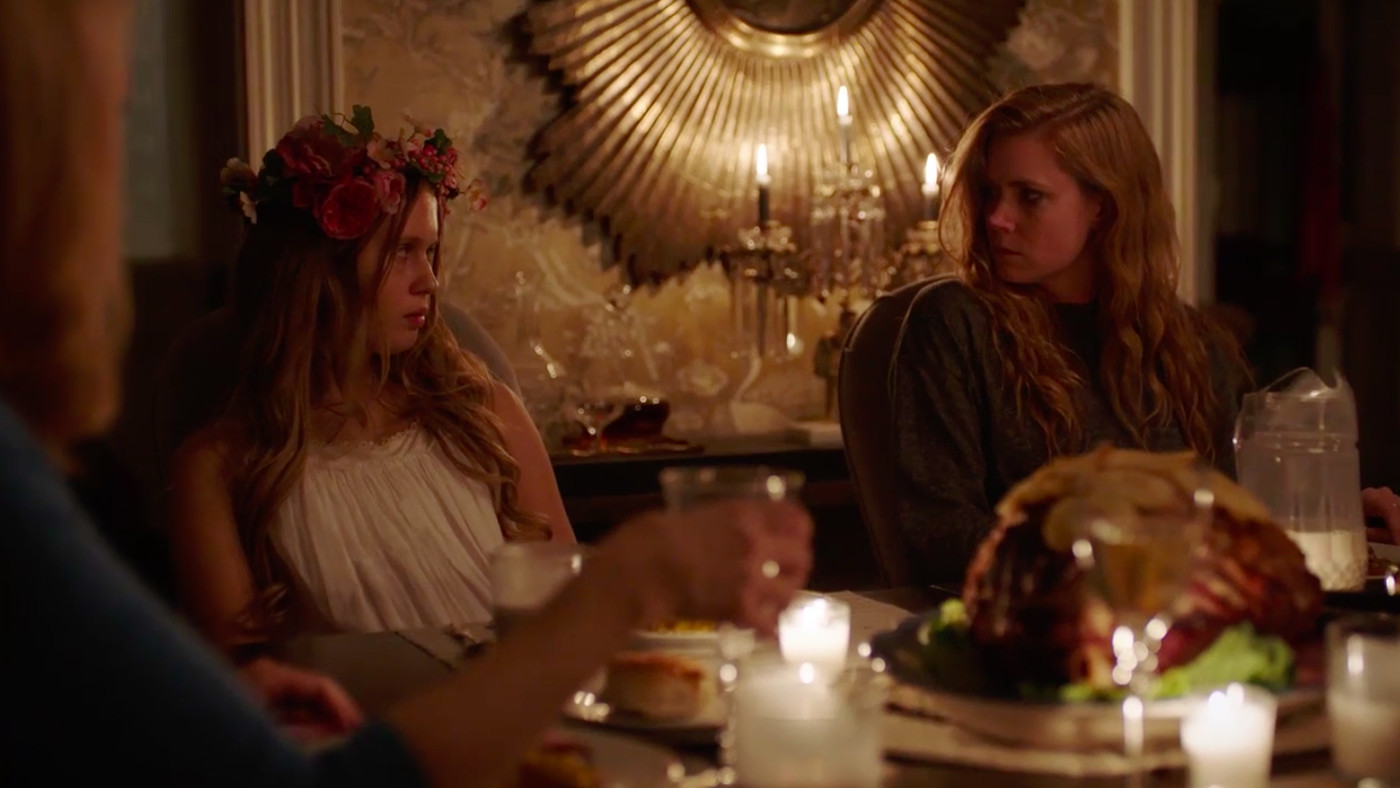
Sharp Objects also features a return to a family house, but in this case, the intruder is our protagonist. Growing up in Wind Gap, Missouri, Camille has only bad memories of her youth—of her sister Marian, who died as a child, of an overbearing and cold mother, and of a childhood marked by violence and fear. Now a journalist, an alcoholic, and attempting to recover from a history of self-harm, Camille is chasing a story: two young girls have been murdered in grisly fashion, and their bodies have been found with their teeth pulled out. Camille’s mother, Adora (Patricia Clarkson), lives in the house with Camille’s stepfather and a daughter Amma (Eliza Scanlen), who Camille has never met. Stepping into the house means resurrecting her childhood memories. These aren’t shown as flashbacks, but as a vivid and inescapable part of the present. Camille sees her younger self and her sister as sort of living memories, walking past her in familiar corridors and peering around bedroom doors. At times, essentially, she is haunted by herself. As past and present bleed together, Camille seems caught permanently between her childhood and her adulthood, her sense of self wavering between what it is now and what it used to be.
Camille’s childhood in the town was full of violent events, little and big, that are revealed to us in flashes of memory: the moment in her teenage years where the popular boys “passed her around” (an incident she refuses, categorically, to talk about as ‘rape’), the petty verbal assaults that the townspeople cover up with sweet Southern politeness, and the clinical, detached way her mother used to interact with her, devoid of any sense of care. A telling moment is when Camille lets an out-of-towner detective, Richard (Chris Messina), touch her. As she achieves orgasm, we see a violent montage—blood dripping on the floor, bloody meat, the dead girls. It’s clear that Camille’s proverbial journey into adulthood was nothing if not violent. It’s less ecstatic than India’s experience, but it’s the other side of the same coin: a ‘coming-of-age’ marked by a harshness, a viscerality.

Camille is a grown woman, but her return home prompts a regression. “I’m an adult now,” she tells her mother. Adora responds: “Not in Wind Gap. When you’re here, you’re my daughter.” If ‘to become adult is to become free’, she isn’t there yet. She forms a tenuous bond with Amma, her thirteen-year-old half-sister, who leads a double life. In the house, she is Adora’s perfect daughter, playing with her dollhouse and allowing herself to be fawned over. Outside, she is Wind Gap’s mean girl, roller-skating around town with her best friends, flirting with the prime murder suspect, and needling Camille with little jibes when she can. Camille seems equal parts frustrated by and protective of Amma. Their interactions remind her sometimes of herself—she was the town’s “it girl” herself, back in the day—and of Marian, someone younger, more beloved by her mother, and more susceptible to danger. In Amma, Camille seems to see a chance to redo her and Marian’s past. Unlike them, Amma can be saved.
At the start of their stories, India and Camille are both alone in the world, fending for themselves. India, newly bereft of her beloved father, has a cold relationship with her mother. At best, Evelyn misunderstands India; at her worst, she tells her, with red-rimmed eyes and a terrifying intensity, “Personally speaking, I can’t wait to watch life tear you apart.” There’s no love lost here. In a similarly charged moment in Sharp Objects, Adora tells Camille of her father, who remains unidentified through the series: “You can’t get close. That’s your father. And it’s why I think I never loved you. You were born to it… that cold nature. I hope that’s some comfort to you.” This line is delivered matter-of-factly, almost flippantly, and it’s chillingly ironic Adora outsources this idea of coldness to someone else when she herself has it in abundance. It becomes even more chilling with the revelation that Adora—who has Munchausen by Proxy syndrome—killed Marian with an overdose of ‘care’.
“Just as a flower does not choose its colour, we are not responsible for what we have come to be.” Who is, then? Both Stoker and Sharp Objects are deeply concerned with blood ties, and the tendencies that can carry through them (“You were born to it”). Part of what makes the bonds between India and Charlie and Camille and Amma so appealing is that there is a kind of insiderhood in those relationships. Not only do Charlie and Amma appeal to India’s and Camille’s sense of singularity in the world, but they also are two of a kind, from the same family tree, a strange sort of twinning. After Whip’s death, India comes to a new epiphany; talking of her hunting trips with her father, she says, “I always thought Dad liked hunting. But tonight I realised he did it for me. He used to say, sometimes you need to do something bad to stop you from doing something worse.” She’s realised, tacitly, that the violence within Charlie is also a violence within herself, something that her father recognized in her.
The transition from adolescence to adulthood can often be unnerving, uncanny, like looking at a photograph of yourself from a new angle. It requires a confrontation with the self, and a confrontation with all the things that make the self. Like most transition periods, it’s also marked by violence, as the old self must make way for the new, adult self. And it’s never linear—it’s not as if we wake up one day and are newly, suddenly, adult. Stoker and Sharp Objects interrogate this idea in different ways, literalizing the violence of growing up, and showing us the freedom in recognizing yourself in the mirror.
India refuses to be under anyone’s thumb. By the end of Stoker, she’s wrested back control—through violence, of course, killing Charlie to avenge her father’s death, and thereby also saving her mother. She leaves her house for the last time. When we see her at the end of the movie, her speech acquires new meaning in its new context:
“Just as the skirt needs the wind to billow, I am not formed of things that are of myself alone. I wear my father’s belt, tied around my mother’s blouse. And shoes, which are from my uncle. This is me. Just as a flower does not choose its colour, we are not responsible for what we have come to be. Only once you realise this do you become free. And to become adult, is to become free.”
India has looked in the mirror and faced herself, and decided she likes what she sees. Her speech is not a denial of responsibility, but an acceptance of herself. In reckoning with the things that make her herself, India is adult, and she is free.

Camille is haunted by the ways she is or isn’t like her family—like Marian, like Adora, like Amma, or like her phantom father. After the discovery of Marian’s murder, Adora is arrested for both that past death and for the murders of the girls in the present. Camille leaves home once and for all, with Amma in tow, intending to raise her in a new environment. In her final piece for the newspaper, she writes:
“As for me, I’ve forgiven myself for failing to save my sister, and given myself over to raising the other. Am I good at caring for Amma because of kindness, or do I like caring for Amma because I have Adora’s sickness? I waver between the two. Especially at night, when my skin begins to pulse. Lately, I’ve been leaning toward kindness.”
Like with so much of their stories, Camille’s speech feels like the flip side to India’s. Having made the long and arduous journey into her past, she has come to a belated kind of growing up, emerging from the other side of violence into a new future. She might not be responsible for whoever it is she has come to be—someone with her mother’s violence, or her father’s coldness. But like India, she acknowledges it—and in acknowledging it, allows herself the possibility to be free.



 Flip Screen
Leave a comment