

Sofia Coppola has dedicated her career to capturing the precarious journey of girlhood. From her directorial debut The Virgin Suicides to Marie Antoinette, Somewhere, The Bling Ring, and The Beguiled, Coppola has consistently proved her profound understanding of the struggle of being a girl in this world. Her latest film follows the true story of young Priscilla Beaulieu and how her world changes after meeting Elvis Presley. Though Priscilla has similar thematic undercurrents to the director’s past projects, Coppola’s empathic lens has never been more clear.
An essential part of Coppola’s directing style is her focus on aesthetics. Blushed pink pastels, silk slip dresses, floral wallpaper, the softness of dimpled skin. Her commitment to creating a pretty picture has at times been to her detriment; in the early films before her auteurist voice was fully formed, Coppola’s work could easily be lumped in the style over substance category. Her ornate compositions and pristinely feminine visuals sometimes overpowered character development or a strong narrative. In Priscilla, Coppola’s signature of building an aesthetically pleasing world finally pays off.
It’s the spring of 1960, a 14-year-old Priscilla (Cailee Spaeny) hangs by the telephone waiting for a call from her romantic winter fling, Elvis Presley (Jacob Elordi). She thinks he’s forgotten about her, but she spends every waking moment thinking of him. Coppola is able to portray Priscilla’s extraordinary circumstances as a universal experience. No matter if it’s the King of Rock & Roll or a next-door neighbour— for a teenage girl, having a crush means insurmountable yearning. After three years of loneliness teased by brief visits, Elvis convinces the Beaulieus to allow Priscilla to move in with him at Graceland, on the promise that she still graduates high school. This is where her life is really supposed to start, an opulent life filled with joy and love in abundance. Priscilla could’ve never anticipated that the compound in Memphis would become her gilded cage, and her new life would be the loneliest one she’s ever known.

Just one year after the release of Baz Luhrmann’s Elvis, Priscilla Presley herself (who executive produced Priscilla and wrote the biography the script is based on) reveals the lesser-known side of the so-called King. Coppola’s movie has no flash, no musical numbers, and barely gives any glimpse of Elvis the icon. Elordi embodies the role with remarkable subtlety and nuance. His performance is so lived-in and fine-tuned that it almost makes any past portrayals seem like a cheap Las Vegas impersonation. Elordi is not afraid to show that Elvis at home — Elvis the boyfriend, then Elvis the husband — is no one to be adored. His presence dominates every environment he’s in, a formidable man with endless power who is surrounded by endless praise, The imbalanced dynamic between Elvis and Priscilla is emphasized by their massive height difference, with Elordi at 6’5” and Spaeny standing at 5’1”. Spaeny is a silent force to be reckoned with. Her performance exudes warmth, innocence, and she takes her time with every line, every reaction, every bat of her lashes.
Coppola and Spaeny form a powerful duo, who together delicately and truthfully portray the very real experience of being groomed into an emotionally volatile relationship. They carefully balance the dialect of glamourizing all the right things and exposing all the wrong things. Of course a teenage girl would be seduced by the amazement that life with Elvis would offer; fame, clothes, jewels— and that’s the least of it. Being loved by someone who is loved by everyone is the ultimate gift, but with Elvis, it comes at a cost. The naïvety is no fault of Priscilla’s, and no fault of anyone still in the midst of their youth. Back then, there was no vocabulary or conversation to describe the subtle and prolonged acts of abuse. Manipulation guised as care, isolation guised as protection, control guised as preference; it all adds up to a complete loss of identity.
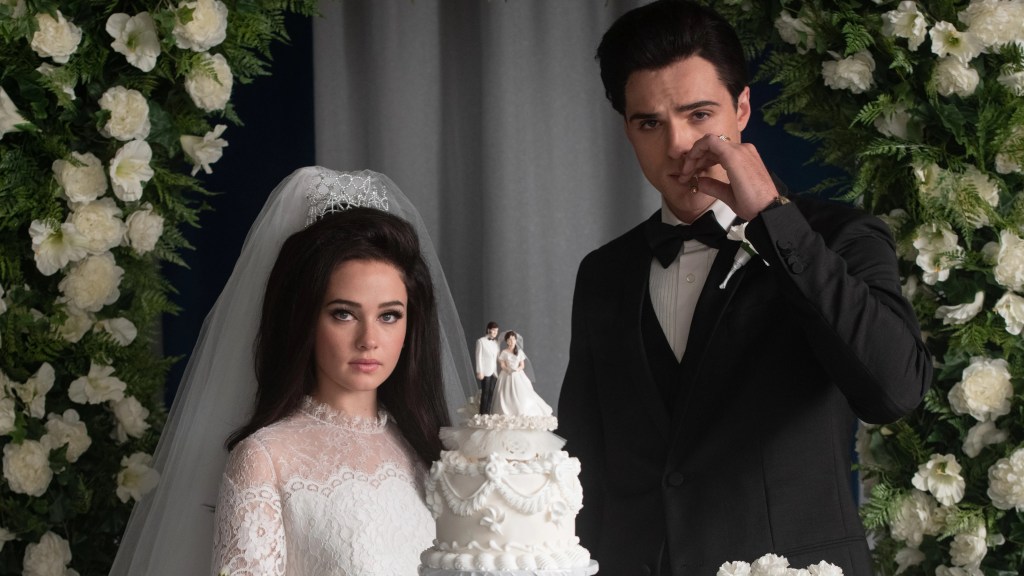
Even marriage, the utmost celebration of love that Priscilla longed for, proved little change in how Elvis treated her. Their relationship wasn’t completely loveless; in many ways, Elvis adored his wife, just not in the same way she adored him. She held onto the tiny moments of intimacy and yearned for more, the same way she used to yearn for his calls. Elvis’s love was conditional, it relied on her not having a life of her own. Priscilla’s identity had to orbit around his. She stayed inside the four walls of Graceland for weeks on end, occupying space in the countless sitting rooms, waiting for the blue suede shoes to walk through the door again. Her exuberant surroundings in contrast to the mundanity of her life is devastating. When Priscilla gives birth to their daughter, Lisa-Marie, her whole world shifts. Caring for a child provides Priscilla with a sense of great responsibility, identity, and most importantly— a purpose in life outside of caring for Elvis. In motherhood, Priscilla finally discovers the freeing feeling of true love.
At its heart, Priscilla is a tale of a young woman coming into her own. Coppola has already put her own journey of finding herself on display by way of her previous films. She has been sharpening her unique perspective on girlhood for the duration of her career, and it makes her the perfect person to tell this story with compassion and truth. There is no better director or a better subject to convey what it’s like to be surrounded by beautiful things, but still feel empty. Unlike a lot of Coppola’s past work, Priscilla concludes with tenderness and pure excitement for what the future holds. It ends with the visceral feeling of a lust for life. Backed by Dolly Parton’s “I Will Always Love You,” Priscilla drives out of the pearly gates of Graceland with Lisa-Marie in the backseat, leaving her interrupted youth behind her. All of the longing, all of the fighting, and all of the hard lessons learned, led up to the most beautiful and satisfying liberation.


 Flip Screen
Leave a comment