When a leaked screener of Kyle Edward Ball’s feature debut Skinamarink reached viral status on YouTube and TikTok, the film quickly garnered attention for its minimalistic approach to scares. Though the film may have come out after the “disturbing movie iceberg” trend died out, many a YouTuber has dedicated themselves to explaining the film or trying to articulate what makes Skinamarink a transgressive nightmare. It’s not an entirely incorrect assumption, but there isn’t that much content to speak of; very little actually happens in the film. Most of the on-screen violence or the scares Kevin experiences happen in the shadows or behind corners. The audience is mostly forced to stare at corners, walls, and disappearing windows through shots littered with visual noise. Even with a rise in horror films taking visual or narrative inspiration from the analog horror or ARGs– like We’re All Going to the World’s Fair, The Outwaters, and the upcoming Backrooms movie, Skinamarink still has almost no close cinematic comparisons.
That being said, Skinamarink does have one notable predecessor: Mark Z. Danielzewski’s novel House of Leaves. The most infamous example of ergodic literature maintains a place on many “most disturbing books of all time” lists for its inventive take on the haunted house. The quite literal intertwining of Ralph Navidson and Johnny Truant’s records and studies of the titular house create a 700 page beast of straight dread. What makes the Navidson Record stand out and consistently draw people in, both in narrative and in real life, is the nebulous nature of what goes on in the house. Readers—like Navidson, Truant, Zampano, and anyone unlucky enough to experience the house—remain left in the dark with only hints of the true horror. Much like Blood Meridian, it’s a book that has received the label “unadaptable” for these reasons. However, decades later, Skinamarink approached the idea of an improbable home shifting and changing and put it onto the screen. Though calling it an adaptation would be a stretch, Skinamarink is probably the closest cinema has gotten to replicating the terror of the Navidson Record and translating the language of ergodic literature to screen.

House of Leaves and Skinamarink both cultivate a strong, distinct atmosphere, but plenty of other haunted house media does as well. The element that makes both stories stick is the lack of context for the—honestly, creative—brutality of the supernatural entity. It can’t be reasoned with, it has no motive, and yet it seems hellbent on inflicting unknowable psychological terror. The world bends to its will and it will not stop, even when the damage seems to be over. It toys with anyone unlucky enough to enter its radius, especially children. Even when the mind-warping terror seemingly pauses, it never completely leaves. Ralph Navidson pressing forward on his documentary nearly tears apart his family, while Johnny Truant becomes so obsessed it starts physically affecting him. Kevin and Kaylee, the siblings in Skinamarink, aren’t lucky enough to catch a break; however, their sheer naivety keeps them in the dark for the first half-hour. But this naivete and honest curiosity only lasts so long. The entity will reassert itself again, not just within the house but marrow-deep in its victims. Reality is turned on its head—quite literally so in Skinamarink—and nobody gets closure.
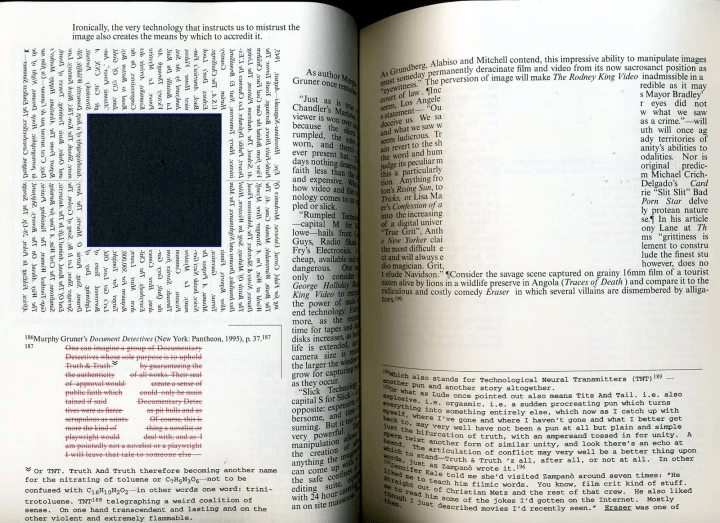
The most obvious similarity between the Navidson Record and Skinamarink comes from their manipulation of space and time. Compared to the general expectations of a haunted house horror, an unknowable entity manipulating space-time provides an opportunity to break free from a conventional linear narrative. Both Danielzewski and Ball use the freedom that their respective entities provide in spades. A hallmark of ergodic literature is experimenting within the bounds of a book page. House of Leaves’s extensive footnotes weaving throughout the Navidson Record comprise the majority of this book’s irregular page layouts; however, sometimes these layouts shift in conjunction with what the house is doing. At several points floods of text suddenly turn into one word or sentence sitting on an otherwise blank page when a member of the party gets lost or passes out. After a hole gets punched in one wall of the improbable hallway, the footnotes spread to fill a similar hole shape on the page. It adds to the immersion, forcing the reader into the same ominous, unknowable hallway and the manipulations that happen within it.
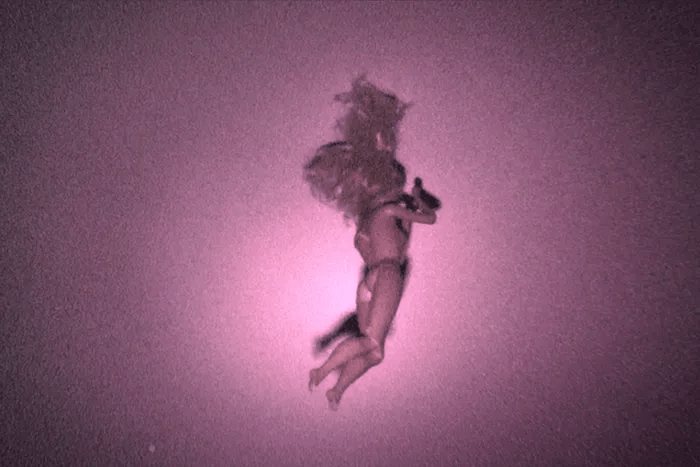
Skinamarink takes the idea of experimenting within the bounds of a medium further with its cinematography and sound design. Where House of Leaves covers its pages with clusters of records and winding footnotes to create a sense of disorientation, Skinamarink pares back its cinematography and sound design for the same effect. The camera focuses on walls, ceilings, and floors with only a few elements of the house framed clearly. A heavy cloud of visual noise and VHS grain leaves most shot locations indistinguishable; with a lack of clear, establishing shots, trying to figure out how much the house has been manipulated is near impossible. As the film progresses, staring at the noise tricks the eyes into seeing the entity that seems to be manipulating the house. It’s impossible to distinguish a vague figure from the static in the increasingly dark, winding space. A very static-driven sound design provides a similar disorienting effect to the ears like the visual noise does to the eyes. With so little dialogue or clear sound, apart from the cartoons on the television, any noise grabs the viewer’s attention. The audience remains in the dark and just as susceptible to the darkness and quiet as the two young children.
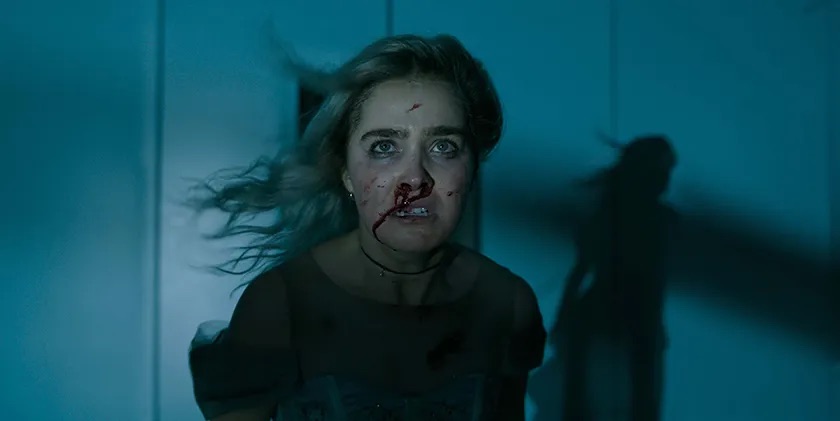
Both House of Leaves and Skinamarink obviously separate themselves from standard haunted house and supernatural horror fare in their content. The unknowable, seemingly amoral spirit that haunts the characters in each story provides enough bone-chilling fear in concept alone. The disorienting shots, largely quiet sound design, and the visual noise and VHS static leaves the audience as confused as the poor kids stuck in infinite, hellish torment in an ever-shifting house. These medium-bending techniques aren’t just gimmicks— they make the fear more tangible, lingering long after the film ends or the final page turns.


 Flip Screen
Leave a comment