
During his interview with Peter Keogh, independent director Jim Jarmusch was told: “It seems that each of your films move further out of town. First to more distant American cities, and now international.” [1] If “town” refers to Hollywood’s mainstream, then Night on Earth perhaps best exemplifies this departure. Filmed with velveteen richness as dusk bleeds into night, this five-vignette film shows a different cab journey in five cities—Los Angeles, New York, Rome, Paris and Helsinki—during one night. Each city features a distinct and thought-provoking passenger and driver interaction; some are funny, others are tragic, all are unified in that the characters find a shared sense of compassion. But in a modern era that shows no signs of slowing down, it is the film’s critique of the American Dream and hypermodernity that is perhaps as important as it ever has been, even more than 30 years after its release.

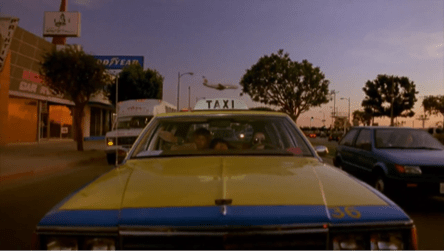
“You’re really happy driving this taxi? Is that your whole goal in life?” asks Victoria, a Hollywood casting agent, who has just offered her charismatic cab driver an acting role. “I want to be a mechanic,” Corky, the driver, declines before dropping her customer off in Beverly Hills and driving away to her next pickup.
Corky’s departure from this Hollywood neighbourhood in the film’s first vignette does not just signify her decline of the offer— it mirrors Jarmusch’s own directorial career. As an independent filmmaker, Jarmusch’s cinema does not conform to mainstream Hollywood conventions. His unhurried film style, characterised by static camera movement and infrequent cuts, is the antithesis of the cut-heavy kinetic cinematography of mainstream narratives. His films have a penchant for exploring the lives of peculiar, unusual characters— Corky is a prime example.
Victoria’s Beverly Hills residence is more than just a taxi destination; it is the nucleus of stardom and wealth, the pinnacle of the American Dream. But for Corky, it is only a temporary stop as she postulates a different version of that dream— one of blue-collar car work. Corky’s nonchalance towards a highly sought-after Hollywood career offers challenges traditional thought around the importance of money and status. Using the film medium to convey this almost disparaging view of the industry is an audacious decision by Jarmusch; perhaps a daring critique of materialism within the industry which he is a reluctant part of himself, and of which his career has sought to break away from.

The film’s colour palette creates vividly candescent images of the nocturnal cityscape in a fashion that has been likened to Edward Hopper’s paintings. [2] Radiant hues of crimson and amber become increasingly present as night sets in, with these vibrant colours reflected on the taxi’s bonnet for much of the ride. A great deal of the film’s drive through the urban landscape of each of the cities is surprisingly featureless. We see extended shots of seemingly bland, desolate spaces of urban modernity, an anti-aesthetic to the galvanising, sleepless cities of twenty-four-hour action we often see in conventional films. [3]
But the setting is far from dull. In relation to “slow cinema,” Andrew Klevan discusses “the undramatic everyday”— the seemingly bland, ordinary elements of quotidian life that tend not to gather much attention in film narratives. Klevan draws on philosopher Stanley Cavell’s argument that history should take interest in “the uneventful,” and seek “what is not out of the ordinary.” [4]

Night on Earth takes an interest in this. We see shots of empty petrol stations, dimly lit empty roads, or vacant car parks. These bland areas epitomise “the undramatic everyday,” seemingly adding nothing to the plot, but everything to the viewer’s precious time. Instead of featuring action-packed storylines, each of the chapters feature slow camerawork and melodic, leisurely dialogue. [5] There are extended periods of stagnancy and inactivity, and what can at times feel like a lack of narrative progression.
It is these moments that make the film special. Klevan asks whether it is possible to discover: “what is fascinating in the ordinary without romanticising it, without transforming it into […] something dramatic.” [6] It seems that Night on Earth has our answer. Through Jarmusch’s presentation of these unglamorous, undramatic spaces, it is possible to find fascination in the ordinary. In Night on Earth, Corky’s preference to work in such spaces instead of Hollywood makes her rejection of the job more powerful; it shows that to some, there is something of value in the ordinary. For perhaps the first time in motion picture history, ordinary is interesting. It adds value. In this way, Corky’s rejection of the job mirrors the film’s slow aesthetic— just as she declines the desirable life of an actress, Jarmusch declines the cinematic fast-paced cinematic conventions of mainstream Hollywood.

Despite the title’s astronomical connotations, Night on Earth revels in the small details. The film is unique in that it is a narrative exclusively comprised of taxi journeys— a seemingly unimportant storyline feature of most mainstream films that often ends up in the editing room bin. But here, Jarmusch turns trash into treasure, taking the audience on a rather pleasant ride.
[1] Peter Keogh, ‘Home and Away’, in American Independent Cinema: A Sight and Sound Reader, ed. by Jim Hillier (London: Palgrave, 2001), pp. 125-130 (p. 125).
[2] Brian Jarvis, ‘“You’ll Never Get It If You Don’t Slow Down, My Friend”: Towards a Rhythmanalysis of the Everyday in the Cinema of Jim Jarmusch and Gus Van Sant’, Journal of American Studies, 54.2 (2020), 385-406 (p. 388).
[3] Ibid. p. 405.
[4] Stanley Cavell, ‘The Ordinary as the Uneventful (A Note on the Annales Historians)’, in Themes Out of School: Effects and Causes (San Francisco: North Point Press, 1984), p. 193.
[5] Andrew Klevan, Disclosure of the Everyday: Undramatic Achievement in Narrative Film (Trowbridge: Flicks, 2000), p. 28.
[6] Klevan, Disclosure of the Everyday, p. 29.




 Flip Screen
Leave a comment