“Chevrollier’s effervescent debut is an immersive coming-of-age tale”
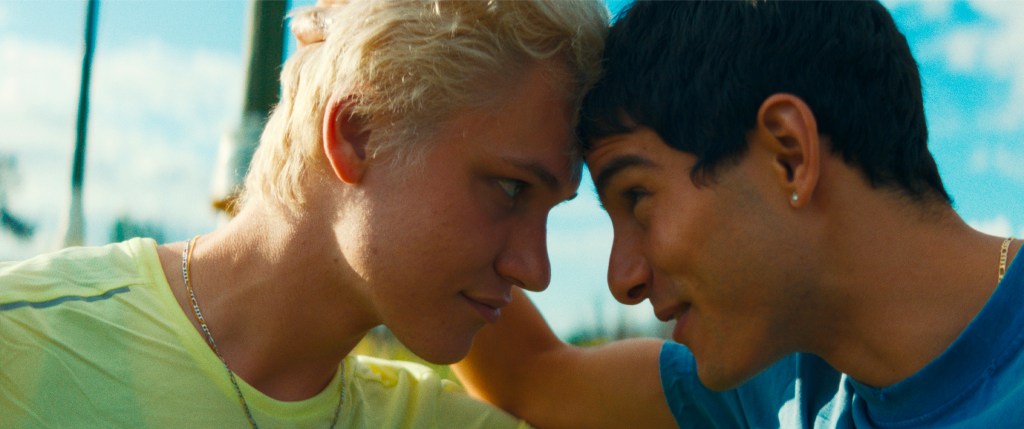
Both on and off screen, the allure of motorcycles extends beyond mere practicality and transportation. Besides conveying a sense of liberation from the constraints of everyday life, they can create a sense of belonging and companionship for the ones riding them. For the protagonists in Antoine Chevrollier’s Block Pass (original title: La Pampa), the vehicle offers a way out. Inseparable friends Willy (Sayyid El Alami) and Jojo (Amaury Foucher) spend most of their time at the local motocross track, dreaming of one day leaving their small town. Jojo is on the verge of winning the national championship under the rigorous coaching of his stern father, David (Damien Bonnard), and the encouraging Teddy (Artus Solaro). Meanwhile, Willy feels that his mother Séverine’s (Florence Janas) boyfriend, Étienne (Mathieu Demy), infringes on their family and the space left by his late father. One evening, Willy discovers a secret Jojo has been harbouring, which forces both to confront the harsh reality of living in a society that leaves little room for divergence from expectations.
Block Pass is the debut feature film of French filmmaker Chevrollier, known for the acclaimed miniseries Oussekine, as well as for directing several episodes of Baron Noir and The Bureau. Even though the film features components familiar to the coming-of-age genre, there are a handful of instances where the tale averts from the expected in favour of delivering something that enriches rather than dilutes the storyline. Prominent examples include how the rhythm and perspective alternate as the story unravels and how the characters themselves organically intersect and diverge, but also in the absence of conflict between the friends after the secret is exposed. Although the script, crafted by Chevrollier, Bérénice Bocquillon and Faïza Guène, feels a little uneven at times, its strengths are persuasive. These strengths include rich characterisation and a considerable amount of generosity as characters are granted space to exist as a way to both confront and lay bare human complexities and ugliness.
“I don’t care if you like dick, but we don’t hide things,” Willy tells Jojo the day after he accidentally caught him having sex with a man. Refreshingly, Jojo’s secret never causes a rift in their relationship—if anything, it strengthens their bond. Although things remain unchanged between the friends, others are less accepting. In popular culture, motorcyclists have frequently been positioned as outsiders to society, but this story proves how the people positioned as outsiders by the mainstream will easily reject within their own group only to continue to feel included and secure themselves. The motocross bikes are dirty and loud and the races themselves testosterone-infused spectacles of heightened virility—this is an environment that upholds certain traditionally masculine ideals and, as soon as Jojo’s secret is out in the open, his previously respected skill and talent becomes worthless. The film, which explores exclusion overall, captures the constant pressure of how one is either an insider or an outsider—one either aligns or not—and the consequences that follow each stance.
While some viewers might dismiss the story as one exploiting queer suffering to teach a lesson about the dangers of homophobia and toxic masculinity, the reality is that the story is never gluttonous in its depiction of torment, neither does it reduce its only openly gay character as a mere function without depth whose sole purpose is to move the plot along. Although Jojo would have been an enthralling character to focus on exclusively, inviting the perspective of Willy doesn’t necessarily mean that the experience of a gay character is only worth telling if a straight character is there to react to it. In this instance, one can’t help but feel that the filmmaker is operating with good intentions and from a place of empathy. The unwaveringly supportive Willy is a witness to Jojo’s pain, but he also suffers by association, which underlines the scope of bigotry and hatred.
From leading to supporting roles, all actors leave an impression regardless of screen time, with performances that range from gentle and introspective to complex and unsettling. Worthy to single out is Bonnard, who masterfully captures the agony, despair, and desperation within David. Instead of falling into clichés, Bonnard conveys unsettling ambiguity in his multifaceted performance. When it comes to the leads, they’re both magnetic. It’s Jojo and Willy against the world, and due to the chemistry between the actors, their tender alliance feels genuine. With piercing eyes and a striking screen presence, newcomer Foucher is persuasive as the charismatic and impetuous Jojo. Meanwhile, El Alami—who worked with Chevrollier on Oussekine—effectively captures Willy’s cautious thoughtfulness and brewing inner turmoil with subtle albeit expressive body language.
In motorsport, each track has an optimal racing line—a more favourable way to tackle the course—and the film’s international title refers to a manoeuvre where a rider effectively obstructs another rider’s path to move forward. On a motocross track, similarly to life, one will encounter obstacles and rugged terrain that can be difficult to navigate. One can play it safe—remain on the predestined route—but, with that decision, one might never advance. With the arrival of the self-assured Marina (Léonie Dahan-Lamort), a fine arts student with whom Willy finds companionship, a different world presents itself. Soon, it becomes clear that deciding to stay on the track itself might be the real failure, as it equals an acceptance and continuation of the pain and toxicity.
Ultimately, the lasting aspect lies in its details. The scorching sunshine that warms naked skin, salty sweat dripping down someone’s face, the smell of dirt and dust whirling in the air, and clothing fluttering as riders accelerate down roads—it’s all part of the sensory experience and compelling world-building Chevrollier offers his viewers. From thrilling moments on the dirt track to the sweeping open fields of the French countryside, Benjamin Roux delivers compelling sun-drenched imagery that evokes a sense of intimacy and nostalgia with its saturated colours and general warmth, only further emphasised by the atmospheric and complementing score by Evgueni and Sacha Galperine. A vigorous portrait of male friendship and the pains of growing up, Chevrollier’s effervescent debut is an immersive coming-of-age tale that encapsulates the vast intricacies that coincide with living in a small town and the unbearable pain of being rejected by the world (and the people) one so desperately wants to be accepted by.
Director: Antoine Chevrollier
Screenplay: Antoine Chevrollier, Bérénice Bocquillon, Faïza Guène
Producer: Nicolas Blanc
Cast: Sayyid El Alami, Amaury Foucher, Damien Bonnard, Florence Janas, Artus Solaro, Léonie Dahan-Lamort, Axelle Fesneau, Mathieu Demy
Cinematographer: Benjamin Roux
Editor: Lilian Corbeille
Music: Evgueni Galperine, Sacha Galperine
Release Date: May 20, 2024 (Critics’ Week, Cannes Film Festival)



 Flip Screen
Leave a comment