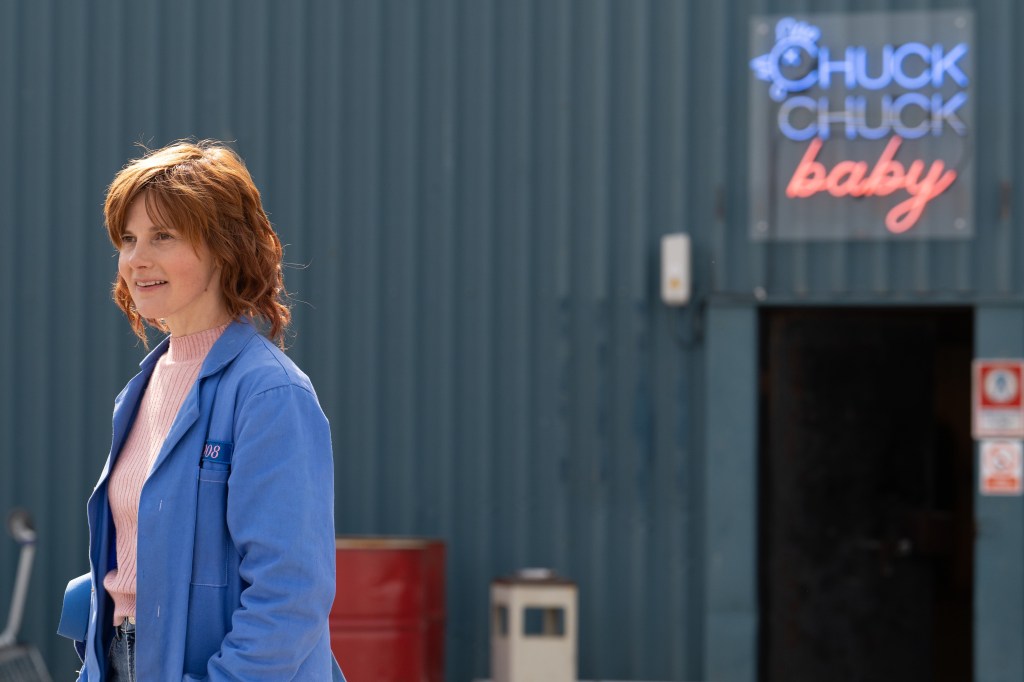
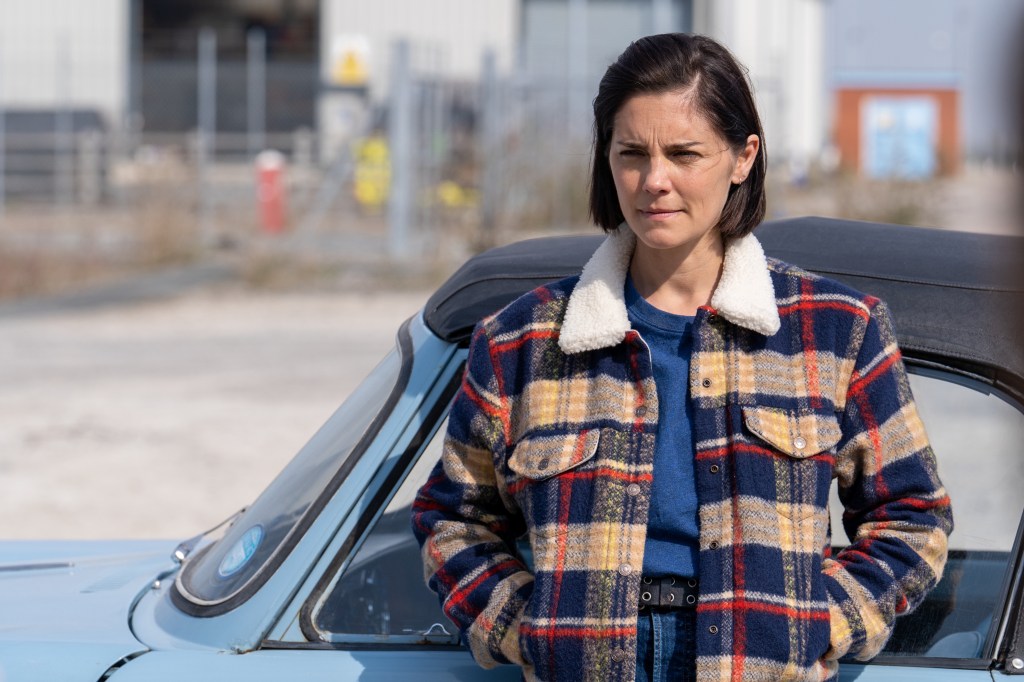
It might seem like a surprising choice to set a story about two women navigating love and loss against the backdrop of a chicken factory, but this is part of the unique charm of Janis Pugh’s new film Chuck Chuck Baby. Helen (Louise Brealey) is a woman who yearns for more than her small town existence, trapped within an unconventional living situation and emotionally tethered to her former husband’s dying mother. When Helen’s former classmate Jo (Annabel Scholey) suddenly moves back home after her father’s passing, their rekindled connection leads to unexpected joy for them both. On the eve of Chuck Chuck Baby‘s world premiere at the Edinburgh Film Festival last August, Flip Screen editor-in-chief Hayley Paskevich, who also reviewed the film, sat down with Pugh, Brealey, and Scholey for a fun and insightful interview.
Hayley Paskevich: Why a chicken factory in North Wales of all places? Like what was it about this particular setting that felt most organic to the story you wanted to tell?
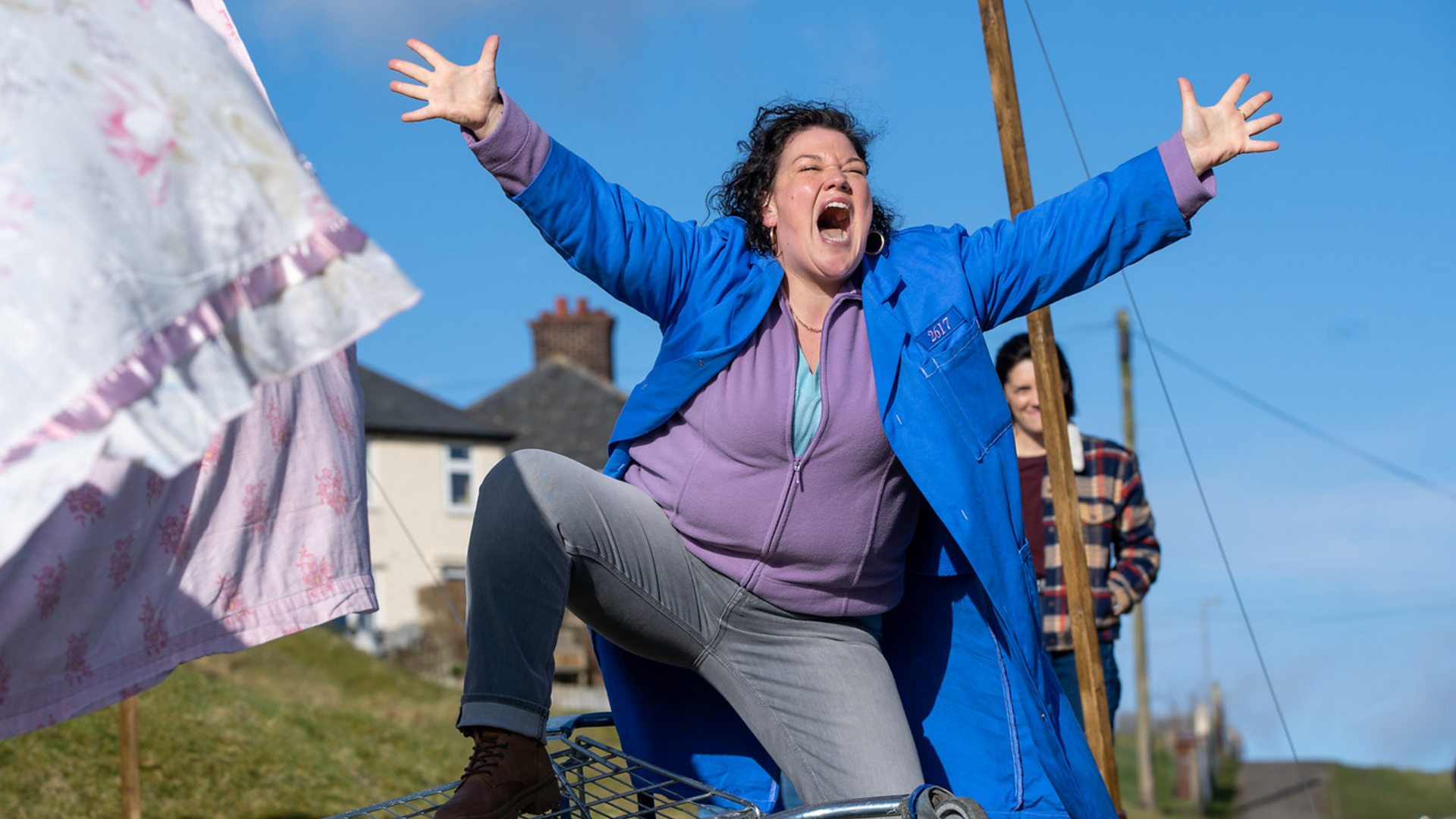
Janis Pugh: I think there’s a certain feel in a chicken factory that is— has a rhythm to it. It has a camaraderie to it with the women. It had— for me it’s a visual aesthetic as well. I worked in a chicken factory. I love the pinkness of the chickens, the blue overalls, the gray kind of concrete, think it’s beautiful. And it’s also, yes— my home has got a chicken factory. [Laughs] It’s my hometown, where I’m shooting.
HP: So there is a bit of a personal experience, that hometown love that you wanted to have communicated through the film.
JP: Yeah.
HP: Oh, that’s wonderful. And what you said about the women actually ties in great to the next question. I noticed that there are various dynamics depicted between women in the film, ranging from the familial to the romantic to the platonic. And that’s something not often seen in one film, like sometimes you’ll have a female romance, that’s really strong. Or they’ll have, like, a friendship, or a mother-daughter sort of relationship. But in Chuck Chuck Baby, you’ve got all of those encompassed in one film. And I was wondering why it was important to you to have it portrayed on screen that way, particularly as a female filmmaker. And for both of you (Louise and Annabel) as women being in this film, what was the onset environment like with it being so heavily female-dominated?
JP: We wanted to make a film that celebrated women, and the love between women in all its different forms. We didn’t want to box anything in. It is about life, it’s about women of a certain age, it’s about the threads and concrete friendships that are cemented through life. It’s about the strength of those women. It’s about how life turns its wheel, and they get on with it. And they get on with it holding hands every single day together. And for me, it’s a real sisterhood kind of— it’s like most small towns, women in small towns— like my own mother, who had five children before she was 29. Only coped—not because I was a naughty child—basically coped because people looked after her kids when she went to work. And it was that kind of tight-knit kind of friendship. And it’s how women, you know, get on in life.
Annabel Scholey: Takes a village to raise a family.
HP: Absolutely. I really love that feeling that you’re trying to capture of the love that is really created between women and that they foster through this community, that was absolutely conveyed in the film.
AS: Like you say, I haven’t seen them all in one before. Like, normally they’ll be— you know, they’ll be focusing on, you know, the rivalry normally.
Louise Brealey: Or there’s— you know, now and again, we’ll get a good lesbian love story. But most of the time, you know, it’s not the whole shebang. And it just feels so refreshing for that, doesn’t it? And it’s that’s refreshing for me as this sort of how specific. like you began by talking about the setting and that world that we also haven’t seen. So those are two huge reasons for me why I wanted to be a part of it from— you know, from day one, because I had, you know, I just hadn’t read anything that encompassed all that love, and also was set in this really specific environment. It feels like it’s both very profoundly specific and universal, you know, managed to just do that magic thing.
HP:I love what you said there. Because like— that’s exactly what I was touching on is how many films will have one or two of those elements, but to have all three is incredibly rare. Chuck Chuck Baby as a film is super unique conceptually. And I think I love the fact that you refer to it as a lesbian love story too, just because I feel like lesbian is so often considered a dirty word. It just has all of these unfortunate connotations.
LB: So Janis as a gay woman isn’t a big fan of the word, but I love it and also it sounds great.
JP: Depends how much I’ve had to drink. [Laughs]
AS: She just doesn’t like the literal word but I mean—
JP: I think talking for me as a lesbian, you know, I think what— going back to what you’re talking about is the whole love. Because I actually don’t think it matters. It’s never mattered to me. You know, I don’t think it matters to anybody in our society about what being lesbian or who you’ve been in love with. Yeah, it’s just a human love. I do like the word lesbian.
LB: I’m just teasing her. But to me it is, it’s a beautiful, it like— I’m— I love the word, I say it often. And I also— I feel really proud to be in a film that’s telling that story among all the other stories. Like for me the story with Gwen is incredibly important in the film, and it wouldn’t work without that balance. And of course, it goes without saying that the whole friendship thing, which is the sort of, you know, real beating heart of stuff. That’s all really important. But also it is a celebration of women loving women. And I’m like, “let’s do it.”
HP: Absolutely. Women loving women, and uplifting and supporting and building that kind of found family and home within the society in all senses of that word. Like— love you said is a very universal experience and I think that’s why— you said, with the setting being so specific yet the film has that universal feel, I think it is because everyone can relate to the feeling of being in love, they can relate to the feeling of finding— hopefully that friendship between like-minded women.
AS: And needing support from each other. My female friends are the ones who’ve kept me going through everything that I’ve been through, always. They’re always there.
HP: Having that fundamental support system, absolutely. Something else I noticed is a very key part of the film is music. Because of how you use it to reflect the character’s inner worlds through the lyrics, I thought that was a really brilliant creative choice. And I was wondering, what led you to choose those specific songs? Especially that one song “Love Song” by Lesley Duncan, which serves as a sort of theme for Helen throughout the film.
JP: I mean, I think the process of finding the music starts right at the beginning. It’s like writing a musical, you have to have the music right at the beginning. It’s always used in a certain way, as you kind of said, as a narrative or an informer of the character’s backstory for the audience. It’s very hard, and it’s very specific. You know, people say to me, “well, it’s just a song.” No, you can’t just go pick a song. It has to work and it has to kind of do what it needs to do for the audience, it has to connect the audience.
AS: Has to take us somewhere. It’s like a scene has— I remember— I think it’s like Robert, what’s his chops? The big sort of story guy, what is his name? Robert McKee? He says “no, no, don’t.” He says, like, “in a scene, an iron bar has to be bent and to be seen to be bent.” And those songs aren’t there as, you know, frilly dressing. They move the story. We find out more about the characters.
HP: Absolutely.
AS: And also it allows them to feel. And I think for me, that was beautiful. And then from there— Janis has been out to bat for every one of those songs, you know, that they’re all really specific. And I need to say about you, Janis— that knowing Janis, she has an amazing encyclopedic knowledge of music. And, you know— so that’s why it’s such an eclectic mix of that. Like I still keep meaning to tell you, “please, can you make me some more playlists?” because this woman just knows her music and I think that— in that regard, as in many, it really reflects Janis. I mean, I don’t want to blow smoke up your arse, Janis.
JP: It’s alright, I don’t mind. [Laughs]
HP: To go back to Helen and Jo’s relationship, I feel like it’s very much characterized by the sense of playfulness and childlike exuberance. What do you think it is about those two characters that draws them back together at this particular moment in time, after they have that sort of shared history from years ago? Like what is it about this current circumstance and who these two women are that you think makes them want to connect now?
AS: I don’t think that they have ever unconnected, I think they are soulmates. And it’s all linked from the same experience of childhood, the same school, the same— growing up in that same place. But I think it’s— a soulmate doesn’t even have to be a romantic soulmate, but sometimes you see a person and you almost see your reflection in them. There’s just a— you know a person because they’re part of you and I think that that’s what they have. So even though Joanne moved away, I don’t think— I feel like they were still attached by—
JP: Absolutely attached.
LB: There’s a beautiful line in Jane Eyre which talks about that thread between their hearts, her and Rochester. And I feel like that’s what it means to me. But it’s also about timing, because the timing’s always been absolute load of rubbish. Timing’s been rubbish just hasn’t it, like for you? And I think that’s the case. You know, actually, there are many times, I think, in all of our lives where it could be the right person at the wrong time. And I think this is—
AS: They’re on seismic shifts.
LB: Yeah, they’re both in a place where suddenly the plates are moved there. Yeah, plates are moving. Only because you, you know, you are at a crossroads. And Joanne is at a crossroads, her father has just died. So I think at those moments in your life, you do reflect that you do go back, you do have a look at what you want, and what you need in your life. And I think that’s why at this particular moment it happens.
AS: That’s right. And I think for me, Helen is— she is trapped by her love for Gwen, you know? It’s been her salvation, that love from this woman. But it’s also held her— and Gwen, you know, Gwen recognizes that and says it in the film. And she can’t— she can’t move until, you know, she loses her. And so the fact that that’s all happening at the same time, I think they would— you know, obviously she’s encouraging that love, you know, in those scenes together. But something, you know, that break, it frees her. I mean, she’s not gonna stay in that house with those guys, let’s be honest, no.
HP: No, absolutely. Feeling that sense of sort of lightness, especially for two women who are going through different things in their lives, but they’re both dealing with grief, like you said, with the loss of her father. And then she’s obviously dealing with the loss of Gwen, her maternal figure, as she’s slowly declining, and that’s hard for her to watch. So for them to both have these periods where they can be together and truly just sort of have these moments of levity within it all and I feel like that’s very important. I also love what you said, Annabel, too, about how they see each other. Like because I know that there was one line, I believe it was your character, and she says that she knows Helen and Helen’s like, “no, you don’t.” And Jo is like, “yes, I do.” And she’s very adamant that she does know who Helen is, even though Helen is obviously kind of repressing that part of herself.
AS: But Jo sees underneath that, and vice versa. I think that’s the point, isn’t it?
LB: I think it’s so interesting. And I really think that our natural chemistry made something else special happen. Like it was absolutely essential that us as people found that connection. Because we just have it don’t we, Bel? Like we just adore each other and we’re just stupid together. And there is a real playfulness in both of us, which we allowed out with— you know, thanks to Janis. And we were able to find that mischievous, yeah.
JP: They’re very naughty together.
LB: We are very naughty together.
HP: I love that. The chemistry definitely came across together on the screen and all the scenes you share together. And I love how as their relationship sort of builds up and you finally do get to the moment where they share that kiss, all the passion comes up and then they’re giggling on the bed. Like really sweet to watch, again, with that sort of youthful aspect that characterises a lot of it. There’s so many lesbian films that oversexualize—
JP: Thank you so much. It’s very, very—
HP: Especially when they’re directed by men.
LB: Let’s get into the scissoring, come on, Janis.
JP: I would like to say lesbian cuddling is as far as we go.
[All laugh]
JP: I think it was important for all of us that this was not— we’re not here to do anything. These two characters ignited a youthfulness in themselves, you know? It wasn’t about the sex or anything else. It was about the love.
LB: But also we’re not shy of the passion.
HP: It’s a very genuine emotional connection between them, that comes across on screen. There’s a physical attraction, but the emotional aspect is sort of the strongest tie.
LB: And I think that’s very real. Because what you— it reminds me of what I was thinking about when you’re saying earlier about the sort of laughter in sort of extremes, you know? Like gallows humor, all of that stuff. Like, life isn’t just— like you cry in happy moments and you laugh in deeply, desperately sad moments. And like, it’s all there. And it’s the same—you know, they are finding this passion, which is gonna release—and does release them actually. And you know— of course it’s sex. It’s not they’re not going to have sex, we just didn’t feel the need to show the sex. Like, you know— and then it wasn’t a sort of—for me anyway, a decision that was anything to do with sort of being prurient, or sort of weirdly coy about bodies and such. Like it was just like, we don’t—
HP: There was no sort of sense of inhibition there.
LB: No, exactly.
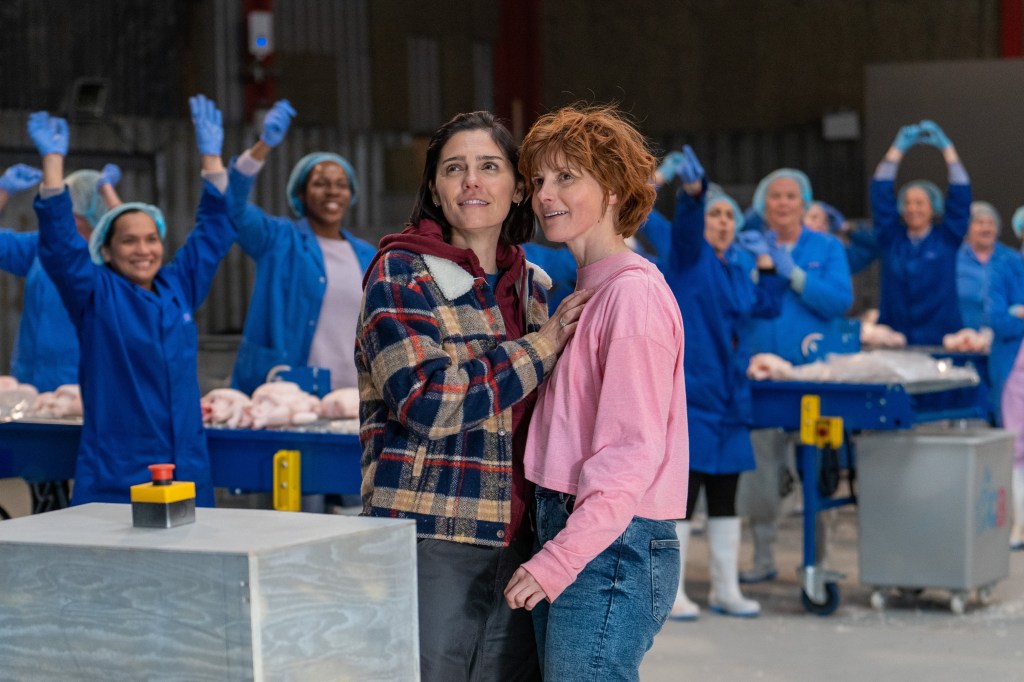
HP: I did think it was nice as well, how— again, within the sort of community of women, there was no stigma about the lesbian relationship. Like it felt very natural, all the girls at the chicken factory were rooting them on. Like, they were very supportive, even Gwen was— [laughs] kind of giving them a nudge to get together in the film. It was only the men who had the problem with it. That was something that really stood out to me.
JP: Yeah. I think women have got more important things to worry about.
HP: Oh, absolutely.
JP: You know, to me— I don’t think it becomes a big issue if there’s two women in love, or two men in love. And I think you celebrate that. And I think that’s what we should be doing. Absolutely without a doubt.
HP: That actually leads perfectly into my final question for you. So there aren’t enough love stories between women that leave audiences feeling hopeful, rather than heartbroken. Is there a particular message you hope people take away from the film?
JP: Do you know what, I think, for me, personally— I’m sure these you know, ladies have their own thing. But for me, tonight is really special. We have a lot of these women from, you know, North Wales. And I think also, as we said, the story is so universal. I think for me, I just want the audience to go with it. I want them to go in the world, and I want them to get carried away, I think they will feel it because I think they’ll see certain reflections in their own lives with this film. And I’d love them to walk away and then— and just break down their own fences.
HP: Breaking down fences, that’s a beautiful metaphor to end that thought on. Do you have anything to add, either of you?
LB: I think you come away feeling positive. It’s a complicated existence. It’s not— you know, you’re working really hard in a factory with no money, you’re worried about putting food on the table for your kid. But I guess the message as well is that within all of that struggle, there is so much beauty in many different areas in life, you know, friendship. And if you’re brave enough to trust your real— your true feelings and follow your heart, then it will pay off, I guess that’s what I would add.
AS: I’m a romantic so I would say that. [Laughs]
HP: I love what you added there because definitely what I took away from the film is life is short, and even if something seems like it’s terrifying, it doesn’t mean it’s not worth pursuing. Sometimes you’ve just got to put yourself out there.
JP: That’s beautiful.
HP: And stop wishing and start doing.
AS: Very good.
[Applause]
LB: Thank you so much.
HP: Thank you for a beautiful film, I watched it with my partner and she really enjoyed it as well.
JP: Oh, lovely.
AS: Glad you enjoyed it so much and really got it, yeah.
HP: No problem. Thank you so much. Best of luck with the world premiere tonight. I’ll be cheering you on.
CHUCK CHUCK BABY will be released in UK & Irish cinemas from 19th July 2024.


 Flip Screen
Leave a comment