

It’s that time of year again. LFF, baby!!!
The London Film Festival doesn’t have too huge a reputation outside its city, really. There are rarely major world premieres (the last truly big one in a while was Guillermo del Toro’s Pinocchio), and the red carpet – whilst extremely fun – doesn’t exactly have the same divine majesty as Cannes or Venice. That’s probably because the LFF red carpet is in a car park.
I love it though. I love the going-to-bed-at-midnight-and-then-waking-up-at-5-in-the-morning-because-I-have-to-get-to-Killers-of-The-Flower-Moon feeling. I love the anticipation, I love the dash from the Picturehouse to Greggs for the third double espresso of the day, before running straight back into the queue. I’ve met some of my best friends in those queues, and met some films that changed my year – and my life. It’s the last major festival of the year, and while the emphasis not being on premieres could mean less new discovery, it’s actually the biggest draw for me. Sundance, Cannes, Venice, Toronto, Telluride, all the best films that have been playing the festival circuit all year have their final hurrah here before release. And it’s public! Anyone can get a ticket. It’s two weeks of the buzziest films of the year, basically on my doorstep. I love walking around my city having it feel slightly heightened by the sheer fun of it all.
I’ve been hitting the festival fairly hard for the past five years, and it’s fun seeing the same merry band get back together every October to go watch stuff. Our tastes are pretty aligned, but alas, sometimes there are times where you must go it alone. One such time was last year, on Day 1, where I strapped in by myself for all four hours of Steve McQueen’s Occupied City, his behemoth documentary on life in Amsterdam under Nazi rule.
I’ve been musing on writing about this ever since I saw it last October. Never got round to it, but since McQueen is returning to open the LFF for the third time (after Widows and Mangrove in 2018 and 2020 respectively) with his hugely-anticipated narrative WWII drama Blitz, I thought the time would be right to crystalise many of the thoughts that have been swirling in my head about it for the past year.
Every McQueen project deals with the precarious relationship the past and present have with each other, whether its in his incredible Small Axe anthology shining a light on the lesser-known heroes of the West Indies community in London during the second half of the 20th century, to illuminate how things are both monumentally different and exactly the same for race relations in Britain. Or his 2013 masterpiece 12 Years a Slave, where protagonist Solomon Northup is constantly, complexly reconciling the life he had as a free man with the brutal one he has as a slave. Weirdly enough, I think the closest comparison point Occupied City has in McQueen’s filmography is his 2018 thriller Widows, a remake of the 80s television series that has the wives of four dead criminals having to pull off a daring heist to pay off their late spouses’ sins. As they train, rob and kill to fight for their future, the ghosts of their husbands are in almost every frame.
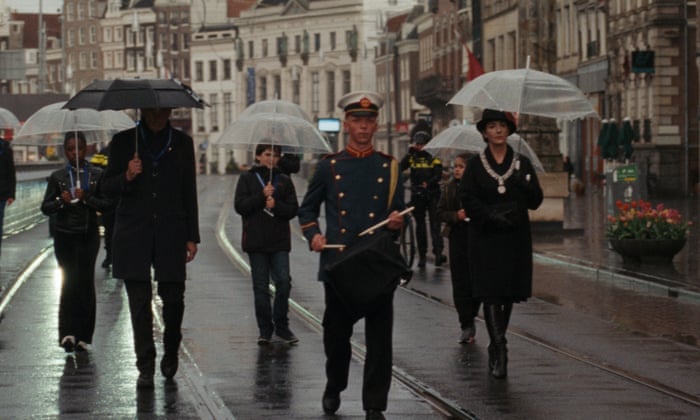
That’s where the comparisons end with Widows, though. That film contains plenty of McQueen’s heady brilliance, but is also by far the most purely entertaining film of his career (not that there’s really any competition, apart from maybe Lovers Rock). Comparatively, Occupied City is basically anti-entertainment. The form of McQueen’s documentary is a step by step, street by street, almost brick by brick collection of stories recounted verbatim from McQueen’s wife Bianca Stigler’s book Atlas of an Occupied City, Amsterdam 1940-1945. This is how it works: McQueen’s camera will rest on a street, or a park, or a particular building in modern-day Amsterdam. Melanie Hyam’s dispassionate narration will tell you about what the location or its occupants were up to during the occupation. Many stories harrowingly end with “Murdered in a concentration camp” if it relates to a person, or simply, if relating to the building itself, “Demolished.”

If it sounds repetitive, well it is. It would be repetitive for a 60 minute Newsnight special, much less four hours at the cinema. There are miner flourishes here or there, such as a rotating drone shot through the city, which departs from the film’s grammar to create a haunting, magnificent depiction of a city both in standstill and completely alive. Or a sequence of elderly Amsterdam residents getting their COVID vaccinations set to Bowie’s “Golden Years”. But almost every other time, it’s this. But the repetition is the point. On and on it goes, as all the stories add up to the vast history of an entire moment in time, giving you a feeling that you both have (almost literally) an encyclopaedic knowledge of the city whilst also the notion that you’ve barely scratched the surface.
I had a completely different interpretation of the juxtaposition at first. You’ll see a pristine, modern building, or a sunny park with children playing, and Hyam will narrate stories of Jewish families hiding for their lives, or prisoners being shot out in the open. And people are walking on by, seemingly unaware. At first, I found this incredibly cynical. Is this McQueen’s point? That a life, a culture, an entire war, have been forgotten? It seemed to be the case where he matches the horrors of some of the Nazi apparatus with modern-day footage of an anti-lockdown protest. The film seems to be saying: you don’t know what true oppression is. How can you forget? How can any of this city be beautiful again? It reminded me of another documentary I saw at the festival that year, Wim Wenders’ Anselm. Theres a moment in it where the titular artist justifies his one of his controversial artistic decisions by stating “You can’t just paint a landscape after tanks have driven through it.
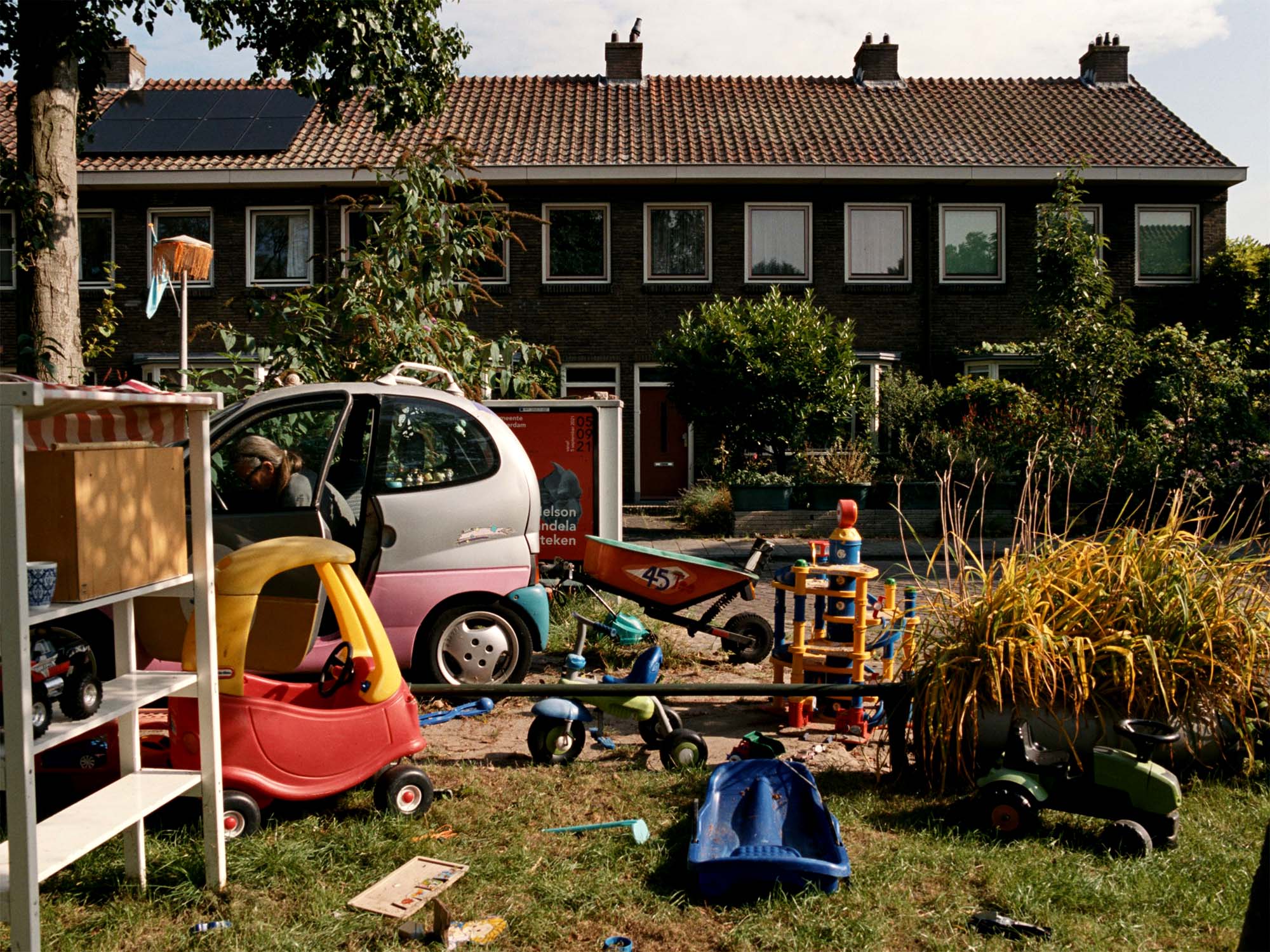
When the intermission started, I dashed to the toilet and then the bar, and genuinely contemplated whether I had the strength to go back in. I admired it, I respected it, but I also think I got it, if that made sense, and saw little reason to go back in for two more hours of the same. Eventually, I decided that I’d made it this far, and would see it through to the end. It was, essentially, two more hours of the same. But something changed. I did. The repetition stopped feeling, well, repetitive. The more I saw of the modern city, despite still hearing of everything it went through, the more I saw McQueen’s film as a statement of irrepressible optimism. I don’t see it as much as a warning about forgetting or ignoring the past, as much as I see it as an ode to the world only spinning forward. There’s a sequence where Hyam narrates a story of a school used for nefarious purposes by the Axis – but now it’s full of kids, walking down, laughing, enjoying themselves, each other, this space.
And something clicked for me; history will always be a ghostly presence, but what matters is the now. Amsterdam was occupied; it isn’t anymore. You’ll hear of Nazi atrocities towards the latter half of the film, but all you see, in the tiny little glimpses of life, is a monument to their failure. The doc was partly shot during COVID, and watching the beautiful yet eerily-empty streets slowly fill up with life and laughter is an emotional punch of its own if you’re attuned enough with the film’s wavelength. It feels like a victory, that people are out, and alive, and happy, and free. And it’s that reaction that made it far more than the four-hour Wikipedia audiobook I thought I had signed in for initially.
At the festival, the film ended with a significantly reduced audience than the one it had at the start, so much that I saw a lot of the people still there gave nods of recognition – and almost admiration – to their fellow moviegoers that stuck it out. I can’t remember if I partook, though. It wasn’t an endurance challenge at all. The film washed over me. I found myself tearing up towards the end, deep in my emotions about it. Amsterdam and its people all went through hell. But It’s all still here. The past in your mind and your present right in front of you. You can choose to see it as a curse. I see it as hope.


 Flip Screen
Leave a comment