
In late 2023, the great Palestinian poet Marwhan Makhoul wrote: “In order for me to write poetry that isn’t political / I must listen to the birds / and in order to hear the birds / the warplanes must be silent.” For the family portrayed in Joshua Oppenheimer’s mad, magnificent, and quietly devastating The End, the poetry they write for themselves comes not from silent warplanes or birdsong, but from the silence of all things above the bunker in which they live after an ambiguous apocalypse. The silence that would becoming deafening if they thought about it for any longer than a second. So they don’t. Almost every trace of the world outside is conscientiously ignored or buried down so they can sing and dance to their heart’s content.
Because Oppenheimer’s debut narrative feature is a musical, but one where it’s almost allergic to the conventions of the genre. The characters rarely sing to express their true emotions; they do it to add a glossy sheen to their lives, burying the darkness under whimsy and light-hearted fun. Like Leos Carax’s Annette (which I’m on record as calling a masterpiece), it’s not a film about people bursting into song and dance as much as an indictment of the people that can express themselves no other way. The inherent optimism and open-heartedness of the style is subverted, corroded. Far less of a left turn than you might think from the man that delivered The Act of Killing and The Look of Silence – two of the most shattering documentaries of the century – it carries their ideologies through with a clear-eyed punch you don’t originally see coming.
“A study in impunity”, as Oppenheimer put it, The End zeroes in on an uber-rich family living it up (and down) at the end of the world. No names are ever given, but we have Mother (Tilda Swinton), Father (Michael Shannon) and Son (George MacKay) amongst the other non-familial occupants who run an ambiguous gamut between friends, chosen family, and the help. They’re not only surviving but thriving apparently. The evidence is the opening song they all harmonise with, rhapsodising on the beauty and satisfaction of the new existence they’ve built for themselves. Again, they’re not singing to truly articulate their inner thoughts, but to kill them off. Mother and Father seem content, and they’ve raised their cultured and dutiful Son to adore them and the only life he’s ever known. Things glide alone in a blissful haze… until the last people on earth hear a knock on the door. The knock is Girl (a still, shattering Moses Ingram), a shell-shocked survivor from the surface who’s lost everything, stumbling upon perhaps the last people in existence, ones who originally are less than pleased to see her. After a very rocky start, the group eventually take her in. And, little by little, just by her lived experience, she throws their carefully-curated lives into an existential crisis.

Image courtesy of MUBI
Oppenheimer’s proscenium arch-esque staging boxes the characters into a beautifully-designed yet deliberately sterile environment that’s both homely and the kind of home the aliens from 2001 would put you in for study. It’s the décor you’d expect from people who focused harder on cramming an example of every artistic movement on the walls than the survival of their fellow man. Swinton, Shannon and McKay typically distinguish themselves as the three leads, playing roles that are both completely in their respective wheelhouses whilst also gently playing against type. Their performances allow the characters to surprise you despite the inevitability of where they’re all going to end up: Mother is both a doting matriarch and a paranoid control freak. Son is a kind and sweet young man until he must confront the realities of his own immense privilege for the first time. And with Father, Shannon gives perhaps the most impressive turn in the movie, with his demure and affable demeanour slowly but surely giving way to his true monstrousness. Their obnoxiousness is tempered by Ingram’s quiet magnitude as the only person in The End you might be able to call blameless for her situation.
They get the three real showstoppers. McKay’s is early on after Girl arrives, and her seeming confirmation from above that they are the last people alive sends him into both giddy braggadocio and terrified panic as he ponces around the salt mines. Mother gets the gut punch; remembering her last conversations with the family she abandoned, and imagining the ones she could’ve had. It’s the most nakedly emotional she’ll ever be in the film, whilst still singing in a way that lets her morally off the hook, and Swinton balances this perfectly. And Shannon’s 11 o-clock number is absolutely, gloriously absurd (it starts off with an apology to the picture of his dead dog), yet still attains a weird level of transcendence in a dream sequence that imagines him finally getting to see sunlight again, before a vaguely homo-erotic dance. It’s kind of hilarious, but like most of the laughs in this film, it sticks in your throat; mostly because like the other characters, he comes so close to an epiphany before deciding to double down on the same behaviour.
The way Oppenheimer twists and corrodes your expectations of a musical – specifically the idea of bursting into song and dance as an act of expression and hope – doesn’t illuminate the characters performing more than it increasingly highlights the emptiness at their core. Like The Act of Killing, it’s all about the reality you invent in your head to stop the guilt and shame from eating you alive. One fraught moment at the dinner table leads to an outpouring of grief from Girl on the family she failed to save, and everyone’s rushed efforts to make her feel better come more from their own desperation to believe it themselves. Because if they don’t, who are they? What have they become? Or, more terribly, has the end of the world lifted their burden to pretend that they were ever anything more in the first place?
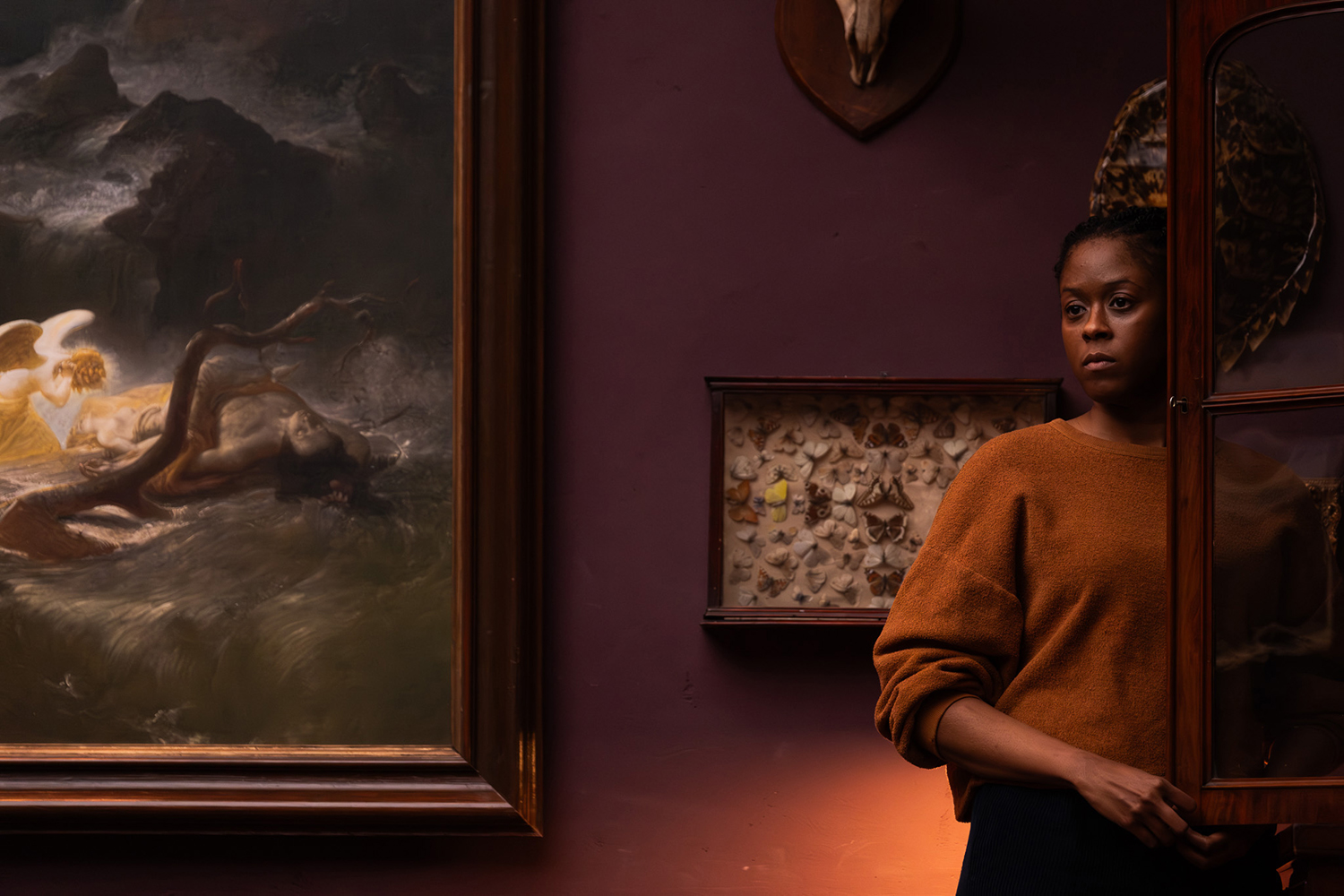
Image courtesy of MUBI
If it’s not obvious already, this is a type of picture that won’t do much for you if you’re not on the wavelength. The film hides a lot of its deceptive subtlety under head-banging obviousness – and for me, somehow pulls it off (there’s a great gag on how Mother hates subtleness because it means “you have to look for it again”). They don’t want to look for anything, or imagine anything except for what’s right in front of them, the only thing they believe in. In this way, it’s genuinely the least likely spiritual successor to The Zone of Interest that 2024 has offered – especially in the ways that the characters have to keep moving, constantly staying busy and distracted. Mother refuses to speak about her family. Son and Father are deep into the process of writing Father’s comically-inflated memoir absolving himself of any responsibility for the present disaster due to his old job as a fossil fuel baron (“we’ll never know if our industry contributed to the collapse”) – and who’s going to read it? And Bronagh Gallagher (a scene-stealer in The Personal History of David Copperfield, flexing different muscles here) who plays Friend, seems to be the moral compass of the group and a second mother to Son, until her own demons are spitefully unearthed. There are no innocents down here anymore. A great deal of the songs are tinged in irony and hypocrisy and self-delusion – which makes the more sincere ones hit with an aching sense of longing and regret.
In the end, we find ourselves with the men believing wholeheartedly in the fantasy world they’ve created for themselves, whilst the framing of the last shot is the women staring straight into the emptiness. And yet, the clarity of this realisation belies the bitterness that ultimately, none of this matters. Every character in this film knows how much they’ve stained their souls – and their species – to get where they are today. And yet, as Oppenheimer presents throughout, pitying these creatures as much as he damns them: what would any sudden remorse or regret accomplish? It’s too late. It’s the end.


 Flip Screen
Leave a comment