
★★★★⯨
“ A testament to the power of independent cinema”
Avid followers of awards season will no doubt have seen Brady Corbet’s name dominate Oscars discussions, and for good reason. His latest project, The Brutalist, is a 3-hour and 35-minute beast— including an intermission —that painstakingly documents each crevice of architect-turned-refugee László Tóth’s arduous and winding journey in America. Audiences are no strangers to three-hour-plus epics now, with Scorsese keeping us well-fed over the past few years via The Irishman and Oscar-snubbed Killers of the Flower Moon, neither of which had an intermission. Not only did I welcome Corbet and his writing partner Mona Fastvold’s decision to include one, but I applaud the way it was used. In fact, I applaud the use of many tools in The Brutalist’s production, not least Lol Crawley’s incredible manipulation of framing and own visual architecture as Director of Photography on this project.

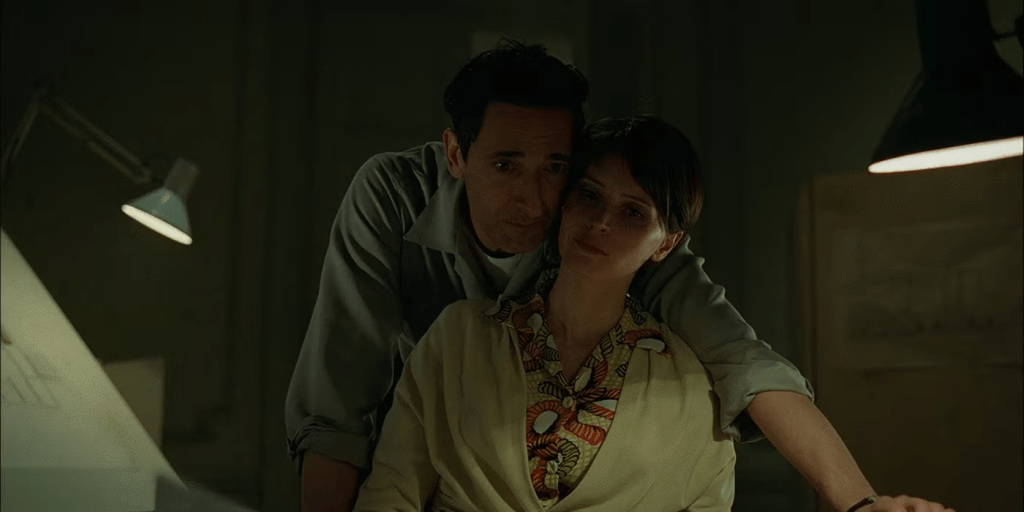
It’s hard to pin down the plot of The Brutalist succinctly due to the scale of the journey László (Adrien Brody, who has already secured critics’ awards for Best Actor) undertakes and the depth of his tribulations. In essence, he is a Hungarian-Jewish architect displaced and disgraced due to his association with the Bauhaus movement, as well as his religion, during the WWII period. Separated from his wife Erzsébet (Felicity Jones), he finds a temporary home and sense of belonging in the company of Harrison Lee (Guy Pearce), a wealthy businessman with an ambitious vision to embody the spirit of his mother in a burdensome yet impressive brutalist community centre. Its construction subsequently brings the destruction of its maker, as Corbet deftly navigates the realities of the deceitful American Dream. Since the UK preview in late November, I have been anticipating The Brutalist’s wide release, and certain scenes haven’t stopped haunting me. Daniel Blumberg’s persistent score married with the incredible colour grading from Máté Ternyik makes Corbet’s vision—much like László’s—all-encompassing.
With partial release on 70mm VistaVision, his choice of medium pushes boundaries and expands form; it’s almost like László’s obsession with structure permeates The Brutalist. This obsession, whilst definitively the cause of most unsavoury consequences in this film, also draws in the themes of beauty, persistence and reward—the three dangling carrots taunting László atop the Statue of Liberty’s torch. László doesn’t find beauty easily, but through Erzsébet’s patient coaxing, a troubled man is rocked to comfort— and eventually confession. This isn’t the first time Jones has played the wife of a man possessed by his work (she notably also does in The Theory of Everything with Eddie Redmayne), nor is she a stranger to performing with empathy around disability. As a character belittled by illness, overshadowed by her husband, and neglected by her niece, Jones manages to communicate Erzsébet’s lack of zest for life—taken from her by the persecution of war—heartbreakingly well.
It’s almost impossible to talk about the successes of such a lengthy film without its runtime cropping up, but perhaps The Brutalist’s only flaw is its ending. After all, three hours of phenomenal filmmaking is hard to round up— Corbet didn’t have an easy job on his hands. But with Corbet’s manipulation of time across both parts one and two of the film, his epilogue falls slightly flat. After documenting the peaks and troughs of a man defined by his potential, Corbet gives us a legacy laden with sympathy for László’s lifelong trials, whilst also a reveal of his long-term genius. Maybe Corbet had quite the challenge in bringing such a weighty narrative to a tidy close, but this ending feels almost too tidy for a man of such mess. Regardless, The Brutalist’s impact is undeniable. With only a $10 million budget, 34 days to shoot and nearly 90,000 metres of processed film, Corbet’s latest is a testament to the power of independent cinema and a strong omen for the modern American Dream. On paper, The Brutalist doesn’t sound like a good time. As a sensory experience however, this film is unforgettable.
Dir: Brady Corbet
Prod: Brookstreet Pictures, Kaplan Morrison, Intake Films, Andrew Lauren Productions
Cast: Adrien Brody, Felicity Jones,
Release date: 20 Dec 2024 (US), 24 Jan 2025 (UK)
Trailer:


 Flip Screen
Leave a comment