
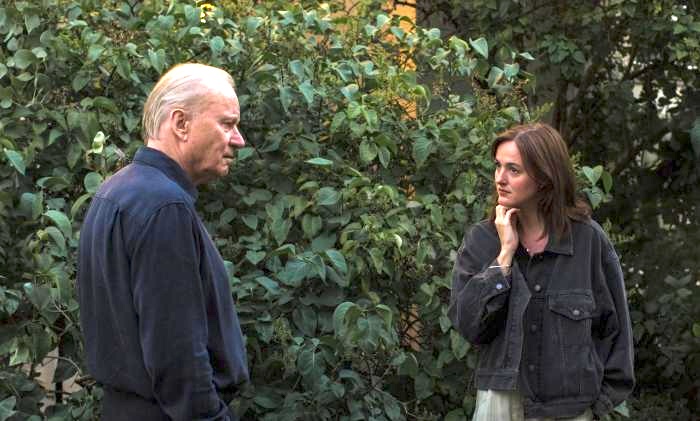
India Donaldson’s directorial debut Good One (2024) is an understated film about the nuances and complexities of human relationships, revealing the disappointments that accompany the journey over the barrier between adolescence and adulthood. Our 17-year-old protagonist, Sam (Lily Collias) embarks on a camping trip in the Catskills with her father, Chris (James Le Gros), accompanied by Chris’s long-time friend Matt (Danny McCarthy), in a would-be bonding trip for the men and their teenage children. However, after Matt’s son’s refusal to accompany his father during a strained period of their relationship, the dynamic of the trip is suddenly altered. What begins as a ruminative exploration of the bond between a father and daughter, juxtaposed with the rift between the lone father and his absent son, turns into an emotional rollercoaster about coming of age and realising that everyone is just as intricate and complicated as us. Good One perfectly encapsulates the rude awakening that is growing up and realising that our parents are not perfect, and that age does not necessarily bring wisdom or maturity. The film reveals the harsh reality that growing up is no walk in the park, it’s a camping trip in the woods.
Donaldson expertly builds a picture of these complex characters, with beautiful visuals of the trio’s escape into nature accompanied by a soothing yet adventurous soundtrack. Our perceptions of these characters change frequently throughout the film as we watch them learn more about each other and themselves, particularly Matt and the introspective journey he undertakes during their retreat into the wild. The trip seems to act as an emotional release for Matt, allowing him to reflect on his relationships and the mistakes he has made. He is particularly open in conversations with Sam, who seems more sympathetic to his obvious turmoil than her father and his mocking and dismissive attitude to his friend’s clear distress. However, Matt’s vulnerability only exposes how far he must go to achieve this growth. When discussing the paths they wish they could have chosen in another life, Matt poses this question to Sam, who replies ‘I think I still get to choose what I do in this one’. Surrounded by men grappling with midlife crises, it is easy to forget that Sam is still just on the cusp of adulthood. Despite her maturity and confidence on the trip, particularly in comparison to her guardians battling their egos and mulling over their regrets, there is still a power dynamic at play between Sam and her companions.

Despite this ostensibly idyllic journey into the wilderness, there is an underlying feeling that something unsettling hides just below the surface. It feels as though we are waiting for one moment to break the building tension, though when this moment finally arrives it is still somehow alarming. After lulling the audience into a false sense of security, a stunned and outraged chorus of ‘What?’ rippled through the cinema at the 2024 Adelaide Film Festival following the film’s sudden shift in tone. This audible reaction emphasises the beauty of seeing films in the cinema and witnessing the audience’s reactions in real time. It reinforces the sense of community that film festivals cultivate and how many conversations can be sparked from the shared experience of watching a film. This response reinforces the shocking nature of this subtle yet climactic moment and how difficult it is to ever truly know a person and their intentions, mirroring Sam’s reaction to this moment. This scene is so beautifully understated, as Sam silently attempts to process what has happened, and the chirping crickets and crackling fire continue on as though nothing has changed. It takes one second for the mood to switch from one of emotional vulnerability to one characterised by unease, instantly reverberating over the first two-thirds of the film and leaving the audience as confused and conflicted as Sam.
Another subtle technique Donaldson uses to highlight the divide between Sam and her male companions is through numerous scenes of Sam sneaking into the woods to change her tampon, which may at first feel like unnecessary inclusions to the narrative but serve as a reminder of her difference in the trio and this added factor she must take into consideration to which the men remain oblivious. Throughout the film, it often feels like Matt is the outlier alongside this father-daughter duo, as his unsuitable attire and underprepared packing contrasts with Chris and Sam’s experienced attitude towards their journey. However, what the film highlights is just how deep the bond between the men goes and how Sam remains an outsider to this dynamic. Sam’s characterisation as the ‘good one’ seals her fate. She is placed in direct contrast with Matt’s son, who is free to acknowledge his father’s flaws and see beyond the facade Matt has constructed. The men are free to articulate their emotions within the film, whilst Sam’s feelings are suppressed and ignored when she attempts to do the same.

Good One is a perceptive exploration of human relationships and just how complex every individual is. Whilst this ending may only be the beginning of unpacking the relationships between these characters, as there is so much left unsaid and unresolved, this confusion and sense of unease mirrors the uncertain nature of the fallout from the events of the film that lingers around these characters. The film leaves us with more questions about these characters than it answers, and brings to mind the debate that circulated throughout 2024: Which would you pick, bear or man?



 Flip Screen
Leave a comment