

Well, it was only a matter of time. In a year that saw both Amy Winehouse and Bob Marley dutifully yet-tritely rendered unto cinematic form, their lives and legacies packaged neatly and conservatively into the three-act structure, the Eye of Sauron has chosen Mr. Bob Dylan as the next subject (or victim) of the Hollywood music biopic. This is despite the slew of exceptional documentaries already produced about the guy – and I’m Not There, a mind-bending experimental film by Todd Haynes that shatters every single trope of the genre.
A Complete Unknown has been in the works now for so long that I did an entire degree in the time between its announcement and release. Despite being directed by the near-universally reliable James Mangold and having the hype of our generation’s defining movie star leading it, I thought the whole enterprise seemed somewhat pointless. Bob Dylan is an artist that defies narrative. His life does not contain the beats of the rousing, rise and fall and rise again that typifies your average biopic. He’s reinvented himself and his music so incessantly over his career, that doing a holistic overview of his entire existence would be a disaster. And despite his enduring talent, Timothée Chalamet is one of the most recognisable men in the world, playing another of the most recognisable (and oft-imitated) men in the world. I expected a lot to go wrong here.
However, it’s good. Actually, very good! They get away with it by wisely side-stepping most of the eye-rolling tropes and instead zeroing in on a very specific yet wide-ranging story, with Dylan at the centre of it all. It’s not a biopic of one man as it is a time capsule for the world that birthed him, then coalesced around him – and one that he irrevocably changed. By design, it doesn’t unpack Dylan as a person per se, but it does expand him.

Mangold’s focused drama begins in 1961. 19-year-old Bobby Dylan has hitchhiked to New York with nothing but his guitar, seeking an audience with his bed-ridden hero, folk singer Woody Guthrie. He finds the hospital bed, and fellow folk hero Pete Seeger (a twinkle-eyed Edward Norton) beside it. He plays them both a song; the two men are impressed, and Seeger gives Dylan a place to stay, slowly integrating him into the Greenwich Village folk scene. He’ll form a relationship with young activist Sylvie Russo (Elle Fanning, name changed from the real-life Suze Rotolo apparently at Dylan’s request), which chafes due to her reasonable desire to actually know something about him. Magnetic folk princess Joan Baez (Monica Barbaro, luminous) will catch his eye. And he’ll write and perform some of the most stunning songs of the century.
Chalamet’s early characterisation is rambling, awkward, restless – and endearing. He has so much to say, but he’d rather say it with a guitar than to any one person in particular. And his musical performances (there is, generously, an unbelievable amount of music performed in the film) are enrapturing. He’s got the voice down pat, but what is captured, both in Mangold’s direction of him and his crowd, is the immediacy of it all. Whether the music is nakedly personal “Song to Woody” or “Don’t Think Twice, It’s Alright”, political (the staging and contextualising of “Masters of War” is impeccable) or trailblazing (“Like a Rolling Stone” is an obvious showstopper), you somehow feel like you’re hearing these iconic songs for the first time. An early highlight is when he debuts “The Times They Are A-Changin’” at the Newport Folk Festival, with magic in the air. The young man gazes at the adoring crowd, seemingly having found a home and a family for himself. Cut to black.
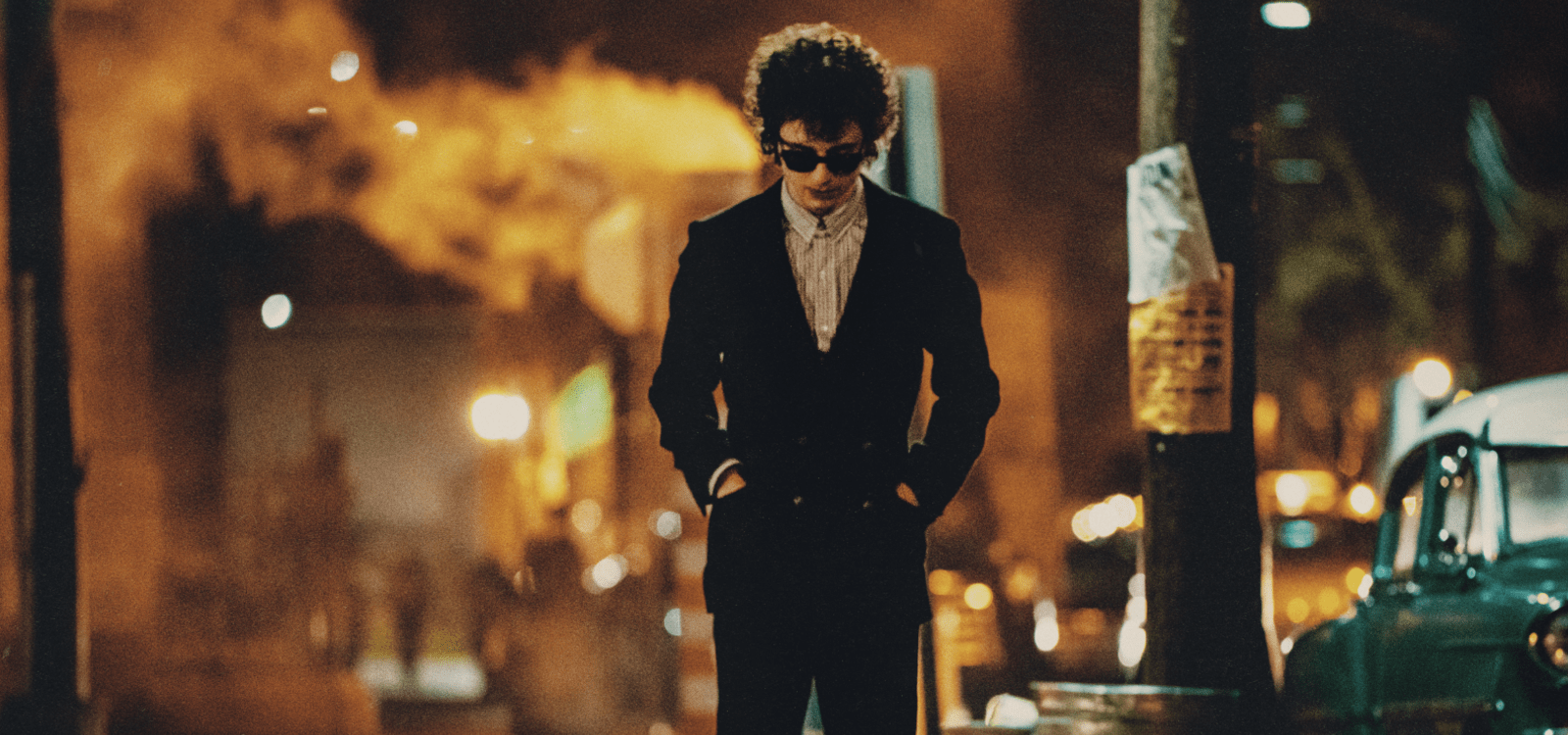
And then, it’s 1965. Dylan snakes out of a bar and walks down the moonlit street, sunglasses on and hands in pocket. Mumbling, reserved, irritable. What happened to this kid? In the blink of an eye, we’ve lost track of him just the same way Russo, Baez and Seeger will; a risky storytelling gamble that ends up paying off well. It’s even more impressive that Dylan himself supported the script; this is partly a story of how he pissed off everyone who ever cared about him and doggedly went his own way in spite of all of them, as he begins to experiment with electric music in defiance of the community that welcomed him with open arms. But it’s here that A Complete Unknown comes alive.
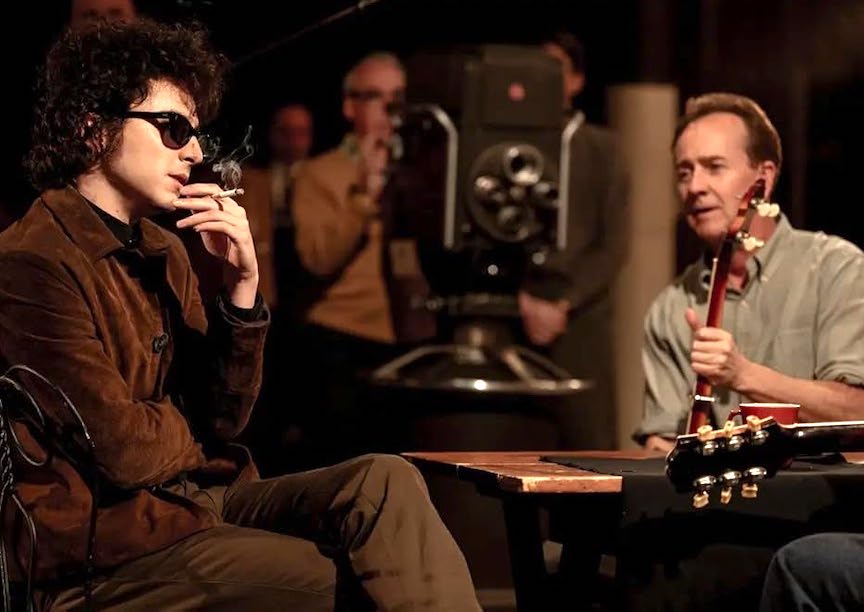
Mangold and his co-screenwriter Jay Cocks understand that Dylan’s innate unknowability is key here, and make very few efforts to decipher it, or “explain” him or his talent. They’re taking their cues from earlier work, of course. I’m Not There fractured Dylan’s personality into six different actors as an act of defiance towards any reasonable attempt at tying the man down. D. A. Pennebaker’s legendary 1967 documentary Don’t Look Back is content to just follow him around, with little to no editorialising. And then, Scorsese’s wildly-entertaining Rolling Thunder Revue highlighted and evangelised a more obscure and fascinating period in his career – whilst also gleefully making shit up at every opportunity.
Chalamet’s Dylan does the same; chiding Suzy and covering himself by explaining that “people remember what they want – they forget the rest.” Did he run away from home? Was he taught guitar at a carnival? Dylan doesn’t want them just to believe any one story; he invites the confusion as protection against anyone truly knowing him at all. He really speaks only through his music, to an extent that it becomes enchanting to the others in his life – and then maddening.
Newport ’65, the controversial historical setpiece the whole film leads to, is great. There are two main accepted characterisations of the event. 1: Dylan debuted a bold and brilliant new electric sound (despite the pleas of the more traditional organisers) that blew open the doors of music and, to quote Marty McFly, “Guess you guys aren’t ready for that yet… but your kids are gonna love it.” Or 2: His stubbornness and dogged individualism resulted in great personal success for him, but permanently stunted the folk movement’s spirit of tradition and community. Mangold doesn’t pick a side; he luxuriates in the prickly emotional ambiguity of it all. You’re entranced by Dylan; you’re heartbroken for Seeger, a man who wants everything to change except the means of expressing it. The film revels in Dylan’s genius and innovation as much as it laments all that it leaves behind in its wake, in a shot of Dylan performing “Rolling Stone” that pulls back from the electricity onstage to the utter shock, confusion, anger and exhilaration of those watching.
He pulls off these contradictions splendidly, throughout. Dylan and Baez are a fabulous musical double-act, but it’s punctured by Fanning’s increasingly-shattering performance, realising that another woman shares something with the man she loves that she never could. Seeger’s a warm, wise mentor to the kid, and an unambiguous force for good, but he’s a deer in the headlights compared to what’s coming. And while Boyd Holbrook’s perma-intoxicated Johnny Cash could be typified as the devil on Dylan’s shoulder, encouraging him to “track some mud on the carpet” and play what he wants, damn the rest – he might be the only one who actually respects his right to artistic freedom.
If the film is unambiguous about anything, it’s the fact that Dylan and Seeger are true artists, and A Complete Unknown honours both of them – as much as it depicts with open eyes the philosophical differences that will tear them apart. Seeger roots all his art in the sociopolitical, using it to provoke real, meaningful change (his introductory scene involves him attempting to banjo-serenade a judge trying to get him sentenced for not naming names). Dylan seems to create his art because he has to, which happens to result in some of the most galvanising and poetic songs ever written – but he rejects and resents any label that is thrown at him. So much that when the opportunity comes to go electric, you feel like part of his reasoning is pure spite. But Chalamet never loses his audience – if he lets you in on anything, it’s a compulsion to run from anything and anyone that suffocates him. Especially when an entire movement based on community has hinged their entire hopes on one man, for better and for worse.
Mangold doesn’t end his engrossing film with any grand statement or summation of Dylan, his choices, his companions, or the movement at large. Chalamet rides into the sunset, alone, leaving Seeger, Russo, Baez – and the audience – to pick up the pieces themselves. At the end, true to the title, he remains a complete unknown. But he – and the film – is still complete.
A Complete Unknown is in cinemas 16th January.




 Flip Screen
Leave a comment