
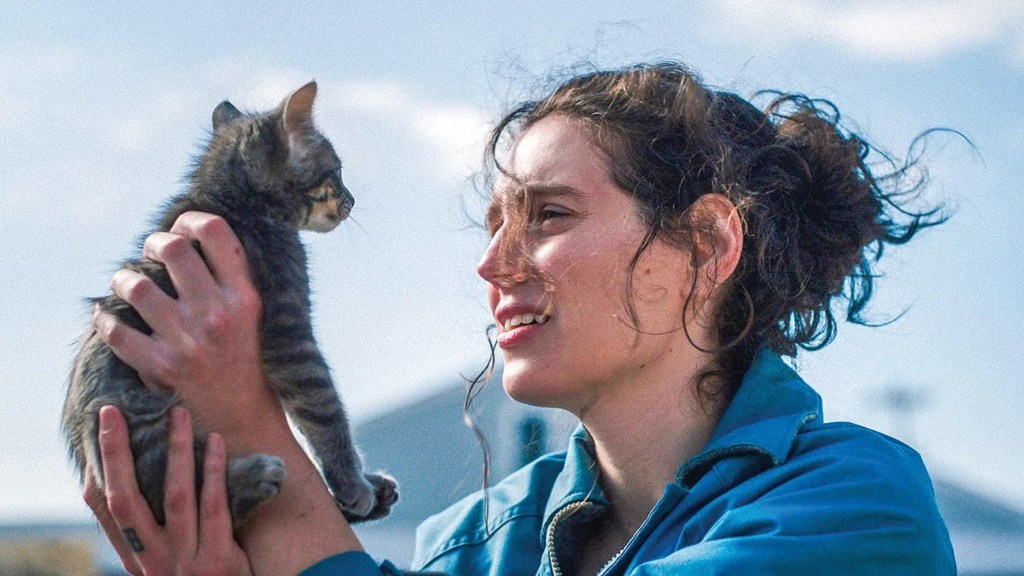
When a film is segmented into distinct, uniquely named chapters, you know it’s really going to have something to say. In what is hard to believe is their directorial debut, Eva Victor crafts a beautiful narrative around the life of Agnes, whose role they bring to life on screen, as a literature professor dealing with the aftermath of a traumatising event. Distilling years of Agnes’s life into these five chapters, we see glimpses of her journey before and after this event, in a time-bending depiction of how life moves on even in the wake of pain and the memories that haunt us. Victor’s Sorry, Baby is a story of resilience. It’s a story of friendship and the road towards healing – a road that is not always straightforward or logical.
By structuring the story with a non-linear narrative, Victor places Agnes’s relationship with her best-friend Lydie (Naomi Ackie) at the forefront of the film. It introduces us to these characters as authentic people with a shared history, and we are immediately captivated by the closeness of their bond. Their jovial and lighthearted dialogue instantly assures us that, no matter what horrors these subsequent flashbacks may reveal – particularly in the ominously titled ‘The Year with the Bad Thing’ – we know this moment is always waiting for us and for these characters. Expertly utilising the tell-tale device of the variation in the length of the protagonist’s hair to signify that time has passed, Victor explores the time leading up to this opening chapter in a simultaneously hilarious and harrowing sequence of events.

Victor has perfect control over the film’s tone, encouraging the audience to laugh in lighter moments and seamlessly transitioning into moments of gravity that never feel jarring or out of place. Her ability to blend laugh-out-loud humour with the severity of the events described reminds us that there can always be light in the darker moments, and that the things that we have been through do not define us. This combination of the light and dark is mirrored within the film’s setting, as the secluded house in the woods connotes both a charming and idyllic image as well as the classic horror movie backdrop. There are moments reminiscent of the horror genre during scenes in which Agnes wakes in the middle of the night to mysterious noises and tentatively explores her seemingly empty house. These moments contrast with scenes bathed in soft light where Agnes jokes with Lydie on her sofa and falls asleep in the comfort of her friend’s presence. Sorry, Baby reminds us of the duality of life, highlighting its ability to contain moments of intense joy as well as, and in spite of, those of pain and fear.
Victor breaks one of the cardinal rules of storytelling – ‘show don’t tell’ – and this may be the best decision that the film makes. By positioning the audience outside the house where this Bad Thing happens to Agnes, watching as the scene turns from day to night, we remain removed from what we can infer is happening on the other side of the door. The audience is placed in the same position as Lydie, as Agnes’s friend and confidant. We know the details of what has occurred only from what Agnes has relayed, and we gain this information from her on her own terms and in her own words. There is nothing voyeuristic about our experience of this moment, we can only listen as we process what Agnes has to say as she comes to terms with this experience herself. Speaking in a Q&A following a screening of the film at London’s Barbican Centre, Victor described the intention behind never giving this act of violence the spotlight. Victor expressed how they didn’t want the audience to know what was happening before Agnes was fully aware of it herself, deliberately avoiding gratuitous violence and centring Agnes in her own story. Because this is Agnes’s story. It is not a story of victimhood or tragedy, but of a person persevering with their life and navigating the consequences of the cards life has dealt them.
No decision is incidental in this film. Even subtle details like Agnes’s wardrobe explore the idea of how an event like this can change our perceptions of the world, as well as of ourselves. By experiencing someone transgress against an established moral boundary, Agnes begins to question other established ‘rules’ – such as the gender binary. Her masculine attire as she assumes her professor role, and her selection of both the ‘male’ and ‘female’ boxes on a form when summoned for jury duty, conveys Agnes’s experimentation with her gender identity. Just as the film refuses to put Agnes in a box or define her by what has happened to her, Agnes refuses to label herself or reduce her experiences to what is convenient for or expected by others. Both a dazzling comedy and a thought-provoking drama, Sorry, Baby is an empathetic exploration of the complexities of the human experience.
Despite dealing with such a heavy and unsettling topic, Sorry, Baby is strangely comforting. The film is bookended by scenes of Agnes and Lydie’s relationship, sealing the events in a protective bubble of love and hope. It reminds us that, though life will inevitably hurt us, it will also heal us – with friendship, cats, baths and great sandwiches.


 Flip Screen
Leave a comment