Richard Linklater’s Nouvelle Vague is a tribute to the filmic movement that arose in France in the late 1950s and 1960s, when a generation of filmmakers began asserting their independence and redefining cinematic language. The title also nods to Cahiers du Cinéma, the legendary magazine founded in 1951 by critic and theorist André Bazin, the so-called spiritual father of French cinephilia. Inspired by Revue du Cinéma, Bazin’s journal became the birthplace of the French New Wave, an influential revolution that shaped arthouse cinema through its Auteur theory for the next few decades.
Nouvelle Vague resolutely anchors towards Jean-Luc Godard, who was at the time a young critic of some renown in Paris’s film circles, and would later become the very embodiment of cinematic modernity. Together with Éric Rohmer and Jacques Rivette, Godard co-founded the short-lived magazine La Gazette du Cinéma, before all three began contributing to Bazin’s Cahiers du Cinéma. Yet dissatisfaction with merely writing about cinema soon pushed these critics toward making their own films. By the late 1950s, Claude Chabrol and François Truffaut had already achieved international acclaim with their remarkable works, Les Cousins (1959) and The 400 Blows (1960) respectively, bringing unparalleled attention to this new generation.
During the same period, Godard returned to Switzerland after his mother’s death. Here he worked at the Grande Dixence Dam and made his first short film Une femme coquette (1955), experiences that laid the groundwork for his debut feature years later. “The best way to criticize a film is to make a film”— a maxim that Godard always kept in mind with his criticism theory and proclaims in Nouvelle Vague. In 1960, he finally took the leap with Breathless, which later turned out to be a revolutionary cornerstone of the French New Wave with its bold storytelling and innovative cinematographic techniques.
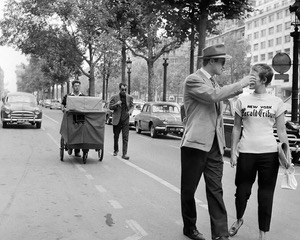
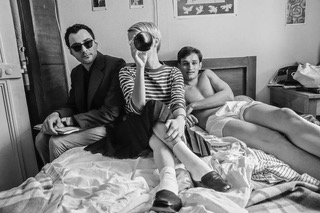
More than a director himself, Linklater also performs as a committed cinephile in this work by meticulously reconstructing the twenty-odd days of Breathless’s production. Shot in luminous black-and-white, Nouvelle Vague almost instantly transports the audience back to the tactile era of celluloid. Played by Guillaume Marbeck, Godard makes a flippant lead in the opening sequence, sharply witted and broodingly cool, with his typical sunglasses that both mask and mirror his restless intellect. Other familiar figures of the movement also parade across the screen in playful title cards— Roberto Rossellini at a salon des célébrités, Robert Bresson shooting Pickpocket (1959) in a subterranean tunnel, Jean-Pierre Melville orchestrating chaos on set. Each cameo appearance evokes not only the glory of a bygone era, but also the ecstasy in rediscovering its pantheon of cinéma.
Jean Seberg and Jean-Paul Belmondo, portrayed by Zoey Deutch and Aubry Dullin, are two other key figures who connect with Godard. Before Breathless, Belmondo was an unknown actor and amateur boxer, while Seberg—already a Hollywood star—was cast for $15,000, nearly one-sixth of the film’s budget. With Truffaut’s help, Godard persuaded producer Georges de Beauregard to finance the project. Initially, Godard wished to work with cinematographer Michel Latouche, but de Beauregard insisted on Raoul Coutard, whose spontaneous and handheld style would become more integral to the film’s characteristic texture.
Notably, while the characters in Nouvelle Vague are based on real historical figures, the actors do not indulge in mere mimicry. Instead, they embody the creative atmosphere of the times with their own understanding, active dynamics emerging beyond temporality. Seberg’s poised intelligence and Belmondo’s roguish charm reignite their on-screen chemistry, sparkling hilariously when it comes to their collaboration with Godard.
The intricate connections between the various members of Cahiers du Cinéma and Godard are also depicted in a series of “farces,” vividly showcasing the distinct personality of this talented and controversial figure. Numerous well-known phrases by Paul Gauguin, T. S. Eliot, Jean-Paul Sartre, and Leonardo da Vinci are rhetorically referenced, which takes the audience back to the atmospheric talk scene among French intellectuals in the middle of the 20th century.
As Linklater has emphasized however, this film is not a simple re-enactment of Breathless but a reimagining— an attempt to re-enter 1959 and relive that world’s spirit, people, and pulse. More than a behind-the-scenes story, Nouvelle Vague reiterates the radical thinking permeated through Breathless: revolution as an art form, which may explain why he chooses Godard as the protagonist. As Seberg complains in the film, “he’s not like Chabrol, nor Truffaut.” Godard was more avant-garde, more uncompromising— a dreamer so immersed in his ideas that they often alienated others. Nonetheless, his success in the industry thereafter demonstrates that alienation can also be an unconventional trait of authenticity, vindicated only with time.
The most famous scene of this innovative classic takes place in the set where Michel rests in Patricia’s apartment in Breathless. Rather than abiding by the recognised rules of editing, Godard unprecedentedly borrowed the “jump cut” technique to create an incoherent and abrupt visual effect. Despite editor Cecile Decugis’s disagreement, Godard insisted on cutting off the continuous footage into leapfrog segments. To his surprise, such a conceit was thought to revolutionize the linear temporal thinking of traditionally edited movies. It quintessentially echoes what Godard says in the film—“reality itself is inherently discontinuous.”
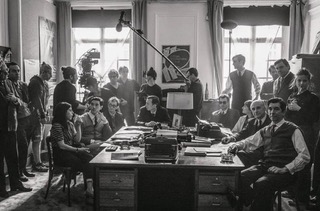
What makes Nouvelle Vague even more ironic, is Linklater’s stylish technical approach. Adverse to the spontaneous, improvisational methods championed by the French New Wave auteur, Nouvelle Vague is scrupulously structured, diaristic in its documentation of each day’s shoot. Yet the contrast as such does not betray the spirit of the French New Wave. It is by means of this deliberate use of traditional editing and narrative sequencing that the film regains its radical essence through reflection rather than imitation.
There is one scene that is perhaps the most moving in the whole film. At the 1959 Cannes premiere of The 400 Blows, when Antoine Doinel’s iconic final freeze frame fades to white, applause erupts just like what is heard at the end of this film. At that moment, the audience dating back over 60 years merges with those watching today. Past and present collapse into one luminous continuum, and cinéma itself is resurrected. Outside the theater, palm trees still sway in the Mediterranean breeze, witnessing the constant celebration of the moving image for over half a century.
But what does it mean to produce a film like Nouvelle Vague today? While Cannes continues to glitter on the global stage, the forces of capital and consumption have eroded the core value of art film. In 2020, Cahiers du Cinéma’s entire editorial team resigned in protest after the magazine was acquired by a group of French investors—a cultural gesture of defiance against the encroachment of corporate control and a political appropriation of what Godard may call “mortal anarchy.” Thus, revisiting the New Wave nowadays is not only an act of remembrance but also one of resistance, a revival of its courage to defy convention, to challenge authority, and to reclaim l’art from the grip of industry.
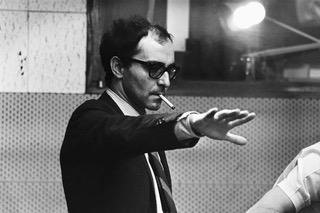
The pioneers of the New Wave have left this world, but their spirit—manifested from their masterpieces—burns brighter than ever, influencing generations of filmmakers from Leos Carax and Olivier Assayas to Philippe Garrel and André Téchiné. Through Nouvelle Vague, Linklater gives a revolutionary glance back at this historic period in the name of Godard, reminding audiences that every film begins small, but within it lies the potential to change the world with its creativity, passion, and faith. In turbulent times, to love cinema and to sustain it remains one of the few acts of belief still available.


 Flip Screen
Leave a comment