It feels safe to say there won’t be another film this year that manages to be quite as zany and boundary-pushing as Good Luck, Have Fun, Don’t Die. Written by Matthew Robinson and directed by Gore Verbinski, the satirical sci-fi takes aim at society’s reliance on technology in a darkly entertaining way, explicitly targeting the normalisation of AI. The plot revolves around Sam Rockwell’s enigmatic character (credited as “The Man from the Future”), who walks into a Los Angeles diner and boldly declares he has come to stop a dangerous AI upgrade from happening, seeking volunteers to help him complete his mission. These roles are filled by an eclectic ensemble cast that includes Zazie Beetz, Juno Temple, Michael Peña, and Asim Chaudhry, each of their characters having something to offer. However, the dark horse among them is Haley Lu Richardson, who delivers a bold and fearless performance with a bizarre yet compelling role that makes her a true standout–– and arguably the film’s secret weapon.
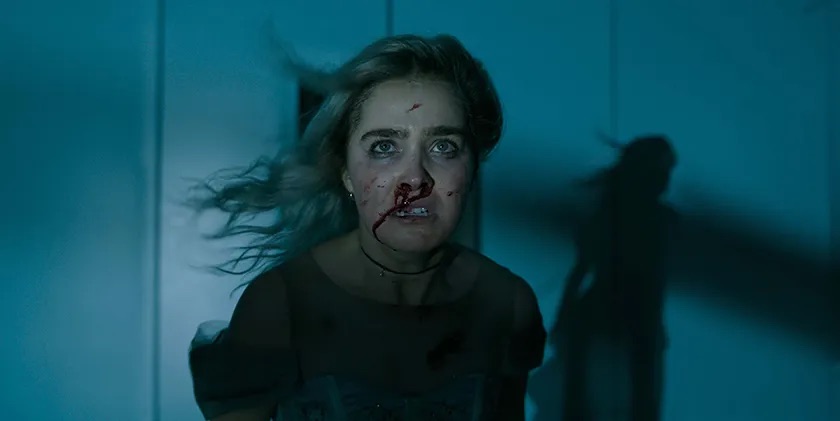
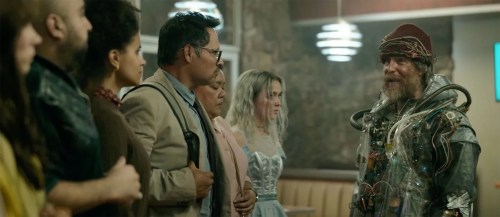
When her character Ingrid is introduced a few minutes into the film’s opening diner scene, she is seen sitting alone at a booth near the back. Her unusual attire instantly draws intrigue as she wears a fancy blue dress that makes her visibly out of place, looking like she has just come from a costume party. Even though Ingrid volunteers herself to join The Man from the Future in his quest after he has selected several people, he refuses to take her at first. However, fate intervenes in the form of a bottle getting knocked onto the floor that points directly towards Ingrid, giving him no other choice but to reluctantly bring her along. It soon becomes apparent that her distinctive outfit, which earns her the nickname “princess,” isn’t the only thing that makes her an outlier. Upon being asked to hand in their cell phones, Ingrid is the only person in the group who does not have one. However, it turns out that she has a good reason for this, which comes to light in an unexpected way when her nose suddenly starts to bleed. Ingrid looks around the group in a panic as she frantically asks if anyone has a phone, explaining that she is allergic to cell phones and wifi before destroying the device.
This reveal adds an interesting layer to Ingrid, and thanks to the film’s established structure of cutting from present action to character-specific flashbacks, the knowledge of her unique condition also enhances the audience’s anticipation for her backstory. But what could have easily been a quirk played for laughs is written in a sympathetic way, with Richardson’s portrayal of Ingrid being genuinely affecting. Ingrid’s peculiar sensitivity inherently disables her, with her ‘allergy’ shown to have a significant impact on the way she lives. Even doctors are perplexed by her brain scans as a child, and as Ingrid gets older and technology advances, it becomes increasingly difficult for her to survive in a world where her physiological triggers are ever present. Still, Ingrid does what she can to take precautions against these things, creating a life for herself that feels safe and manageable. She makes a living through regular gigs as a birthday princess, a low-risk job which involves dressing up to entertain at children’s parties. At one of these parties Ingrid even falls in love after meeting a man named Tim (Tom Taylor) who seems to be an ideal partner, especially since he appears to share her aversion to technology.
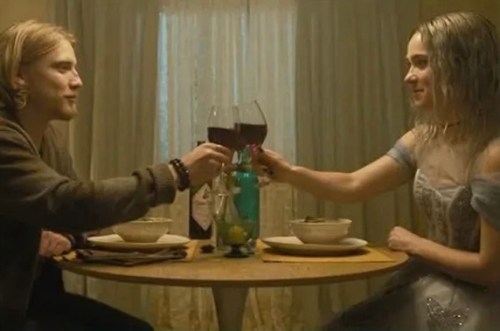
The two begin a romantic relationship not long afterwards, as Ingrid jumps on the back of Tim’s motorbike and they ride off into domestic bliss. Modern electronic devices are noticeably absent in their shared home, with everything from clocks to radios being analog. While Ingrid feels at peace cohabitating with Tim, the couple’s honeymoon phase ends when an unexpected package arrives, which turns out to be a VR headset. Tim reassures Ingrid he will get rid of the technology if it hurts her, but soon becomes completely sucked into the virtual reality world. His decision to put on the headset ultimately does end up hurting Ingrid, albeit in an emotional way rather than the physical one he feared, choosing to leave her in favour of joining life in a different reality. Even though the situation itself is far-fetched, Richardson is able to make the emotional stakes feel authentic and grounded. She does an excellent job in expressing Ingrid’s confusion, hurt, and utter devastation over Tim’s choice, with the dinner scene between her and Taylor being one of the moments where she really gets to shine.
Ingrid’s relationship isn’t the only casualty of this sudden technological intrusion. She is horrified to discover that even children’s birthday parties are no longer cell phone free zones, experiencing a severe nosebleed while bringing out a cake. Her allergic reaction quickly turns a celebratory event into a traumatic one, as the children scream in terror and the birthday girl’s mother freaks out. It is devastating to see that despite all the measures Ingrid has taken in order to protect herself, technology has somehow still managed to force its way into her life. Ingrid flees the party and discards her princess crown, knowing the role is no longer sustainable with her condition. Having lost the stability and comfort of both her job and relationship, Ingrid’s willingness to jump into a life-or-death situation seems like more than just a bold choice— it seems self-sacrificial. This is especially evident when she watches a car fall from above, standing directly in its path and nearly letting it crush her until she gets pushed out of the way. But while Ingrid may consider her own life expendable, it soon becomes apparent that she is anything but.
In the film’s climax, Ingrid shows up to save the day when all hope seems lost, her arrival signaled by the now-characteristic drops of blood. The shot where she comes into full view is particularly striking with how it is framed through the doorway, Ingrid’s silhouette positioned at the center of a technological maelstrom. Watching her bravely venture into a room that contains the source of so much suffering throughout her life feels like an incredibly triumphant payoff, and Richardson is a knockout here. The sheer intensity she brings to the moment while also conveying Ingrid’s immense physical pain makes her an absolute force on screen, in a bloody and powerful scene that is easily one of the film’s most memorable.
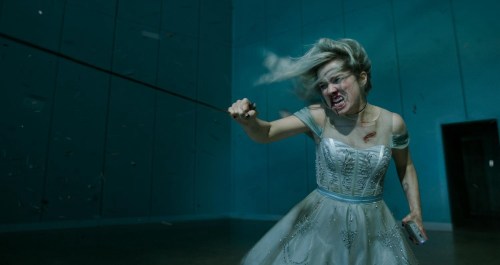
Without entirely spoiling the third act twist, Ingrid also comes to learn something about herself that recontextualizes her role within the group’s mission. This knowledge adds an even greater depth and purpose to her character, with Richardson able to convincingly navigate the more challenging emotional beats required. Even though Good Luck, Have Fun, Don’t Die leaves its viewers with many questions when the credits roll, there is no question Ingrid will be one of the main reasons the film stays fresh in the audience’s memory, with Richardson’s impactful performance unlikely to be forgotten about any time in the near future.



 Flip Screen
Leave a comment