

When acclaimed filmmaker and creator extraordinaire David Lynch tragically passed away last year, affectionate words from both fans and colleagues flooded all corners of the internet. Given how multifaceted Lynch was, it’s no surprise that the tributes are too. In a career spanning over 50 years, Lynch continually developed and refined his distinctive approach and style by experimenting beyond convention to craft something unique. There are many qualities that make Lynch inimitable, a handful of which have been highlighted here in recognition of his influence and skill.
Born in Missoula, Montana, Lynch studied painting before he began making short films in the late 1960s. After years of financial challenges, the completion and release of his first feature, Eraserhead (1977) was made possible by securing additional funds, including regular donations from friends, as well as the money Lynch earned from taking up a paper route delivering The Wall Street Journal. Although it suffered a slow start both critically and commercially, the film eventually achieved success as a midnight movie. Today, Eraserhead is renowned for its cultural and historical significance and frequently praised for its evocative audiovisual language.
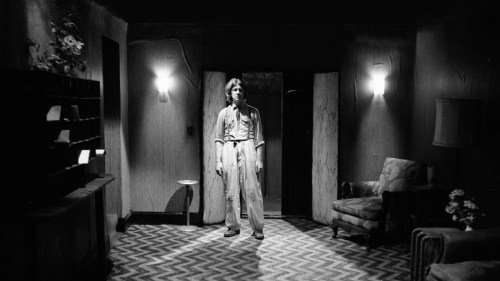
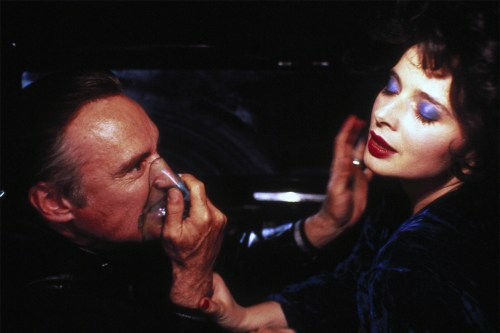
Lynch’s notable career influences can be traced back to his early life, particularly the contrast between his idyllic suburban childhood, with its green grass and tree-lined streets, and his young adulthood, plagued by distress from living in a neighbourhood suffering from high crime rates and deteriorating socioeconomic conditions. Due to these vastly different experiences, it’s not surprising that Lynch so precisely captured the idea of the American dream only to expose its cracks. He did this successfully since he understood pristinely presented façades and the corruption and rot beneath them—not because he purely loathed it, but because he also loved it. His fascination with Americana was always present, whether it was the blue skies and white picket fences in Blue Velvet (1986), the small-town diners and gas stations in Twin Peaks (1990-1991, 2017), the Midwestern countryside of The Straight Story (1999), or the seedy reality of Hollywood in Mulholland Drive (2001).
The contradiction of Lynch’s early experiences would come to fuel his exploration of the world in terms of good and evil, light and dark. His oeuvre portrays the love and danger of the world, how they coexist and the driving force behind both. He was intrigued by the complex duality of human nature and life itself. Because of this, Lynch could combine the gentle with the unsettling like no one else, and illustrate life’s darkness and the beauty that appears throughout. His dreams and nightmares oscillate between beauty and chaos, as well as tenderness and a peculiar sense of humour. Just as the real world consists of a wide range of individuals, so does Lynch’s. His creations are inhabited by courteous, charming, goofy, and kindhearted characters, but also merciless murderers, sadistic abusers, and sleazy criminals.
Lynch’s unconventional artistry may have began with his mother, who wouldn’t let him use colouring books as she thought they would stifle his creativity. This freedom to create, without restrictions and rules, would pave the way to lifelong originality. His versatility is noticeable not only in the endearing visuals of Nicolas Cage singing Elvis Presley in a snakeskin jacket and Michael Cera dressed as Marlon Brando’s character in The Wild One, but also in timeless, chilling imagery. Whether it’s BOB crawling over a sofa towards the camera in Twin Peaks, the invasive and eerie introduction of the Mystery Man in Lost Highway (1997), the unsettling tone achieved by filming Inland Empire (2006) with a Sony DSR-PD150, or the suspenseful build-up to the person hiding in the alley behind a diner in Mulholland Drive, it’s all forever etched into the viewer’s mind. In a way that is more subtle yet equally memorable, he also takes away the neutrality of the mundane, including ceiling fans, electricity, gas masks, and traffic lights at an intersection at nighttime.
When speaking of Lynch, one can’t disregard a certain television series. As soon as FBI Special Agent Dale Cooper (Kyle MacLachlan) drove into the fictional Pacific Northwest town of Twin Peaks with his 1981 Dodge Diplomat, things would never be the same. Co-created with Mark Frost, Twin Peaks demonstrated the possibilities of the medium, and its influence is irrefutable on series associated with the contemporary golden age of television, including The Sopranos (1999-2007) and The Leftovers (2014-2017). Although the focus is on solving the murder of a teenage girl, the investigation uncovers more than it initially set out to, including domestic horrors and the lasting impact of grief and trauma. To this day, the series continues to captivate audiences through its blend of eccentric characters, offbeat humour, and the seamless integration of soap opera elements with horror, mystery, and the supernatural.
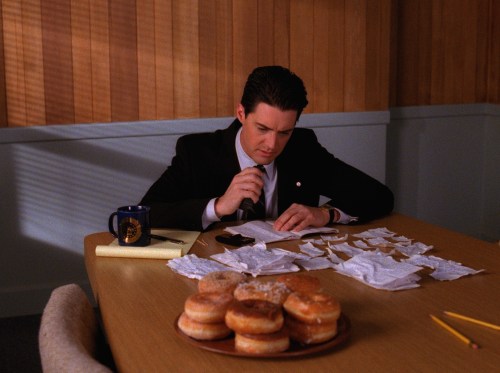
With the show’s 2017 return, viewers were treated to one of Lynch’s purest visions aired weekly. It’s rare to watch a season unfold and know whilst watching it, that something remarkable is happening. Like the original seasons, Twin Peaks: The Return was an entirely new experience that cemented its own place within television history. With all eighteen episodes directed by Lynch and penned by him along with Frost, this was their magnum opus, a project that saw the creative pairing liberated from previous compromise. Instead of relying on nostalgia to easily please fans, these highly anticipated new episodes forced viewers to confront their own expectations through the story’s examination of space, time, and memory.
Far from the comforting small-town romance viewers knew of, everything instead felt distant and foreign. If one looks to Lynch’s beloved The Wizard of Oz (1939), the expression “There’s no place like home” is, if taken literally, quite disconcerting. The idea of home is someplace familiar and secure, but what happens when that safety disappears? Equivalent to growing old and visiting your hometown for the first time in years, Twin Peaks: The Return features familiar elements whilst emphasising that things will never be the same. Chasing the past is pointless, as it will always be in vain—we can’t go back, and it’s insane to think that we ever could. Still, patience is rewarded, as when Angelo Badalamenti’s iconic “Laura Palmer’s Theme” plays for the first time, allowing years’ worth of emotions to resurface. It feels as if no time at all has passed, whilst also providing relief that not everything is long gone, just different.
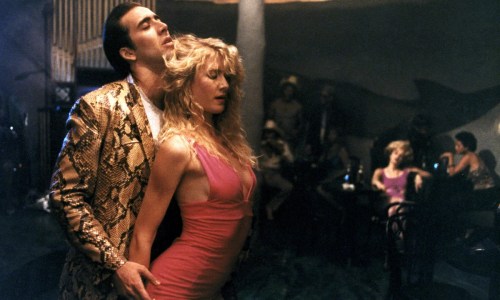
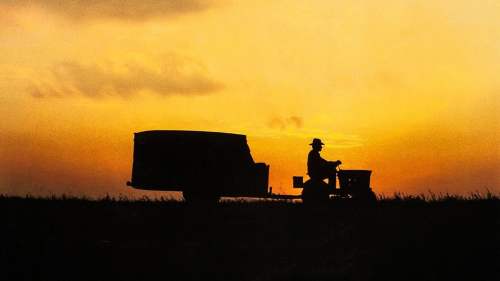
While the most commonly mentioned characteristics of Lynch’s work include his ventures into the dreamlike and surreal, he shouldn’t be overlooked for his romanticism and sincerity. In Wild at Heart (1990), Glinda the Good Witch (Sheryl Lee) urges Sailor (Cage) not to turn away from love. Based on the novel of the same name by Barry Gifford, Lynch altered the original ending, which saw the central couple split up, because he didn’t think it reflected how they felt for each other. Despite the film’s extreme violence, it is essentially a fantastical fairytale about finding light in the darkest places. Similarly, The Straight Story follows Alvin (Richard Farnsworth) as he travels from Iowa to Wisconsin on a lawnmower to reconcile with his estranged brother before it’s too late. Based on a true story, the film emphasises the kindness of strangers, human resilience, and the importance of taking the time to gaze up at the stars, even though time is finite. However, perhaps the sweetest example of Lynch’s gentleness occurs in the first episode of Twin Peaks’s second season.
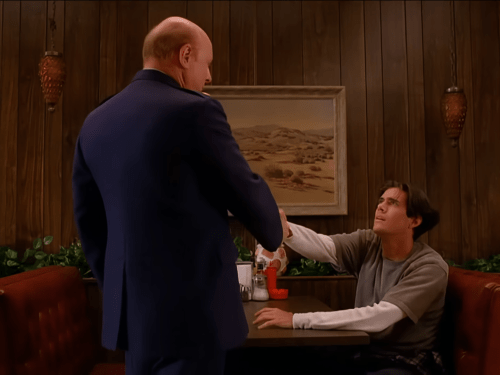
At the Double R Diner, Bobby (Dana Ashbrook) reluctantly joins his father, Major Briggs (Don S. Davis), in a booth. After a while, Major Briggs shares a vision he recently had. The vision, abstract yet specific, is one of confidence and harmony regarding Bobby’s future, and ends with a loving handshake between the two. “Really?” Bobby responds with childlike wonder. Before this scene, their relationship was mostly defined by the rift between Bobby’s unruly behaviour and his father’s austere, authoritative persona. The optimism in his father’s vision offers Bobby, a troublesome teenager often entangled in darker plots, hope that his life trajectory isn’t already predetermined. Making bad decisions doesn’t necessarily make you a bad person, and there’s always the possibility of change. Just as the opening scene of Blue Velvet, with its nest of swarming insects beneath a perfectly kept lawn, encapsulates Lynch’s penchant for exploring darkness beneath pristine surfaces, this monologue summarises another recurring side of Lynch—one that is deeply spiritual, lovingly tender and poignantly optimistic.
Unquestionably singular, Lynch was a once-in-a-lifetime artist who enriched the world with his craft and vision. Beyond the great loss of an inspiring artist, the loss of the individual is just as devastating. The avid coffee drinker, Eagle Scout, and devout practitioner of transcendental meditation discussed golden sunshine and beautiful blue skies during his online weather reports, enjoyed woodworking, and taught the world how to repair pants. Every day for seven years, he drank coffee and had a chocolate milkshake at Bob’s Big Boy whilst scribbling down his ideas on the diner’s napkins. He sat on the corner of Hollywood Boulevard and La Brea, accompanied by a cow and a large canvas that read “For Your Consideration: Laura Dern” to highlight Dern’s performance in Inland Empire, simply because he didn’t have the money others did to spend on billboards or magazine ads. The anecdotes are many, but they all encapsulate why Lynch was special and why the world feels significantly emptier with his absence.
He was generous and openhearted, caring for his characters as well as those who portrayed them, many of whom would become his frequent collaborators. Although limitless in his creative expression, he proved that one didn’t have to suffer or be cruel to create meaningful art. The reason why Lynch triumphed is why his countless imitators will always fail—he wasn’t ironic or sardonic. He genuinely believed, fully and deeply, in everything he did. Lynch knew that for as long as there was darkness, there was also light. Evil might never be defeated, and the damage will never be fully repaired. But people can choose to persist, and solely believing in that notion is a rebellious act in a world that thrives on hopelessness and violence.
In Lost Highway, Fred (Bill Pullman) says he dislikes video cameras because he wants to remember things in his own way, not necessarily as they happened. Throughout his career, people perpetually sought explanations of Lynch’s work, something he wasn’t interested in giving. Instead, he wanted the art to talk for itself and viewers to be more intuitive. If one were to set aside the idea of trying to decipher a singular meaning behind it all, they would discover not solely the humane, but also the personal. Lynch’s numerous ventures into the subconscious offer a glimpse into his own dreams, fears, and inspirations, as seen in Eraserhead’s explorations of fatherhood. His rich cinematic landscapes are an engrossing experience for all senses. As a result, his work transcends language. Sometimes plot details are lost over time, but viewers will always remember how certain films made them feel or the thoughts they spawned. Lynch’s work often toys with the notion of what is real and what isn’t, but does it really matter?
From his first love of painting to the discovery of film, Lynch spent more than five decades bending and breaking the rules of each medium he encountered. When discussing Lynch’s body of work, there’s a distinct separation between before and after, not only in terms of its impact on the creative industry. Watching his creations for the first time felt akin to entering another world, a universe where the grotesque was allowed to be tender, and beauty emerged within the ugly. He presented a language, one that could articulate the emotions for which it is difficult to find the right words. Lynch never ignored the hurt and pain of life, but he offered something to counteract it, even if only temporarily, and created a legacy as he encouraged us to colour outside the lines. Amidst the sadness of his passing over a year later, it feels impossible not to simultaneously acknowledge the privilege of having experienced the world through his eyes in the first place.


 Flip Screen
Leave a comment